

A local citation is any online mention of your business name, address, and phone number, whether on a directory, a map platform, or a niche listing site. The single highest-value move is not building new citations. It’s auditing your existing ones and fixing every inconsistency you find, because a mismatched suite number or an old phone number quietly undermines the trust signals search engines and AI tools rely on to confirm your business is real.
TL;DR:
- Auditing existing citations for NAP inconsistencies is more impactful than creating new ones, especially for businesses with multiple locations or high competition.
- Prioritize claiming and optimizing Tier 1 platforms like Google, Apple, Bing, and Facebook before expanding to aggregators and niche directories.
- Regular audits every six to twelve months are necessary to maintain accuracy, and immediate checks are required after rebranding or address changes.
- Hiring vendors for large-scale citation management requires ensuring they provide proof of indexation, account access, and a detailed change log.
- Focusing on accurate, consistent listings on key platforms and authoritative niche sites significantly improves local search performance more than sheer quantity.
Table of Contents
- What Local Citations SEO Actually Means: Structure and Components
- Why Citations Matter for Rankings and AI Discovery
- Where to Build Local Citation Sites: A Tiered Approach
- How to Audit Your Citations and Fix NAP Errors
- Building New Citations: Manual Work, Aggregators, or Hired Help
- How Often to Audit: Monitoring Cadence and Maintenance
- Measuring Impact: Where to Focus Your Citation Effort
- Envision Marketing Agency’s Approach to Citation Audits
- Perspective: DIY Citation Cleanup or Bring in Help
- Get a Citation Audit From a Team That Treats It Like Infrastructure
- Sources
What Local Citations SEO Actually Means: Structure and Components
Local citations SEO comes down to two building blocks: the core NAP (name, address, phone number) and the optional layer that surrounds it, including hours, website URL, business descriptions, categories, and photos. The more complete and accurate that surrounding data, the more useful the listing becomes.
Not every citation looks the same. Some are structured, meaning they live in a formatted directory field, like a Yelp or Bing Places listing. Others are unstructured, meaning your business gets mentioned in a blog post, a news article, or a social caption without a formal data field attached.
- Structured listings act as verification checkpoints search engines can crawl and cross-reference.
- Unstructured mentions add context and relevance signals but carry less direct ranking weight.
- Search engines and AI assistants both treat consistent structured data as a trust marker when deciding which businesses to surface for a local query.
Why Citations Matter for Rankings and AI Discovery
Citations play a smaller direct role in local rankings than most business owners assume. Their real power is indirect. Accurate listings on Google Business Profile and Apple Business Connect contribute a modest but real share of ranking weight, while their bigger payoff comes through GBP verification, review generation, and the backlinks they create.
Effective citation strategies can help businesses perform significantly stronger in online search, according to Uberall’s research, largely because consistent listings validate that a business is legitimate and actually operates where it claims to.
Citations matter most in three situations: when you’re competing in a crowded local market, when you’ve just opened a new location, and when you’re managing NAP data across multiple branches. A single-location business in a low-competition niche can get away with a thinner citation profile. A five-location dental practice in a major metro cannot.
Where to Build Local Citation Sites: A Tiered Approach
Not all listings deserve equal effort. Work through these tiers in order rather than submitting to fifty directories at once.
- Tier 1 platforms first. Google Business Profile, Apple Business Connect, Bing Places, and Facebook carry the most weight because they feed data to countless smaller sites and power map results directly.
- Data aggregators second. Services that distribute your NAP to dozens of downstream directories create a cascade effect. One accurate submission here can correct or populate listings you’d never find manually.
- Niche and industry directories third. A listing on an authoritative trade association site or chamber of commerce page often carries more topical relevance than a dozen generic directories combined.
- Local media and community sites last. Local news outlets, neighborhood association pages, and event sponsor listings round out a citation profile without demanding much active maintenance.
Claiming your Google Business Profile should happen before anything else on this list, since it anchors most of what follows.
How to Audit Your Citations and Fix NAP Errors
Run this checklist before you build a single new listing.
- Search your exact business name and phone number. Check the first three pages of results and note every listing that surfaces, including ones you never created.
- Run a citation finder tool. Platforms built for this, like the ones BrightLocal offers, export a list of existing citations so you’re not hunting one by one.
- Standardize formatting across every listing. Decide once whether you write “Suite 200” or “Ste. 200,” whether you use a local area code or a toll-free number, and apply that format everywhere, since local area codes still function as a proximity signal on many platforms.
- Flag duplicates fed by aggregators. These often appear because an old address or a previous phone number got picked up before you corrected it. Most platforms let you claim and merge or request removal directly through their support forms.
Pro Tip: Keep a single spreadsheet with your “master NAP” record, formatted exactly as you want it everywhere. Every time you update a listing, check it against that master row instead of trusting memory.
Building New Citations: Manual Work, Aggregators, or Hired Help
Three paths exist for adding citations, and each fits a different situation.
- Manual submission works best for a small set of high-value listings, like Tier 1 platforms and niche industry sites, where getting the category, description, and formatting exactly right matters more than speed.
- Aggregator and listing-management tools scale faster, pushing your NAP to dozens of directories from one dashboard. The trade-off is that aggregator-fed listings sometimes need cleanup after the fact, since automated distribution doesn’t always catch formatting quirks specific to a given directory.
- Hiring a vendor makes sense once the volume outpaces your time. Before signing anything, demand indexation proof, login access to every account created, and a spreadsheet documenting every change made, because vendors that won’t hand over access are usually hiding sloppy work.
Whichever route you choose, exact-match formatting is non-negotiable. A directory that lists “Ste” where another lists “Suite” creates the exact inconsistency an audit is designed to catch.
How Often to Audit: Monitoring Cadence and Maintenance
Citation work isn’t a one-time project. Industry guidance points to a 6 to 12 month audit cycle for routine cleanup, with immediate audits triggered any time you move locations, rebrand, or change your phone number.
Track a small set of KPIs so this stays measurable:
- NAP consistency rate across your top 20 to 30 listings.
- Number of unclaimed or duplicate listings discovered per audit.
- Count of indexed citations showing up in search results.
- Referral traffic arriving from directory listings, visible in your analytics.
A basic spreadsheet plus a citation finder run twice a year covers most small businesses without needing dedicated software.
Measuring Impact: Where to Focus Your Citation Effort
Don’t chase an arbitrary citation count. Benchmark against your direct local competitors instead, and aim to match or exceed their presence on the listings that actually carry weight in your market.
- Prioritize Tier 1 profiles and any niche directory relevant to your industry over generic mass-submission sites.
- Watch for movement in local pack appearances and organic rankings for your core local keywords after each cleanup round.
- Track referral traffic from directories in your analytics platform to see which listings actually send visitors, not just links.
- Treat a local chamber of commerce or trade association spotlight as a high-value citation, since topical relevance from an authoritative niche site can outweigh several general directories.
Envision Marketing Agency’s Approach to Citation Audits
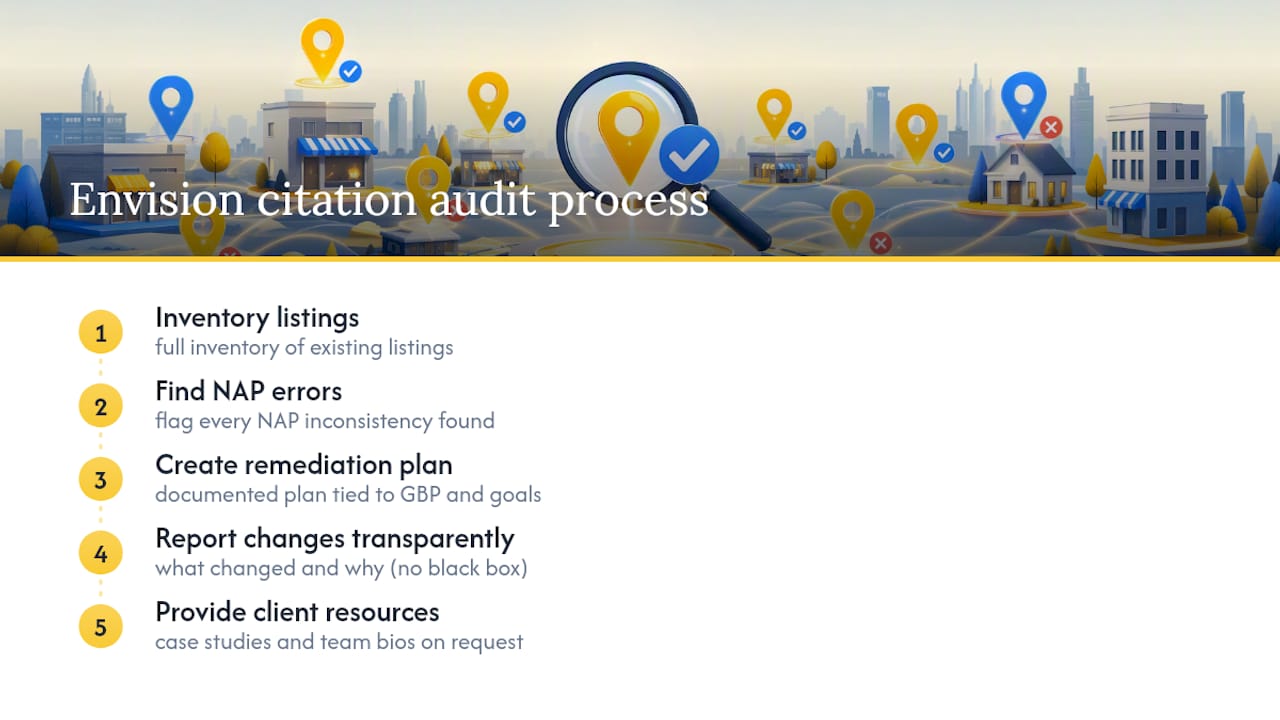
Envision Marketing Agency has worked with businesses across professional services, healthcare, legal, and e-commerce since 2020, building over 550 client relationships around one principle: measurable results over vanity metrics. A citation audit through Envision starts with a full inventory of existing listings, flags every NAP inconsistency found, and hands clients a documented remediation plan tied to their Google Business Profile and local ranking goals. Clients get transparent reporting on what changed and why, not a black-box process. Case studies and team bios are available on request through Envision’s client resources.
Perspective: DIY Citation Cleanup or Bring in Help
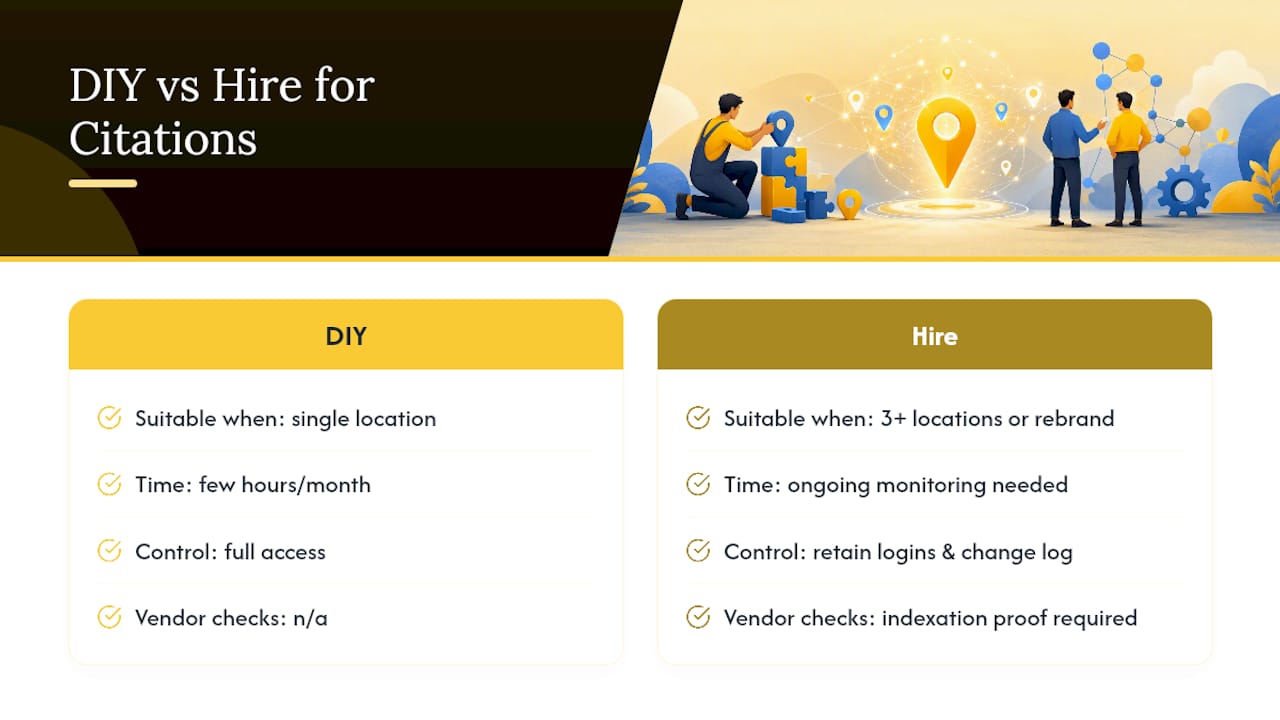
Most single-location businesses with a few hours a month can handle citation audits themselves. The math changes once you’re managing three or more locations, dealing with a recent rebrand, or simply don’t have anyone on staff who enjoys spreadsheet work.
If you do hire out, vet vendors hard: ask for indexation proof, insist on retaining login access to every platform, and require a change log you can review yourself. A good agency adds monitoring, structured data cleanup, and ongoing Google Business Profile optimization on top of basic submissions. A weak one just files forms and disappears.
— Marcus
Get a Citation Audit From a Team That Treats It Like Infrastructure
Running your own citation audit with a spreadsheet and a few hours works fine for a single location with light competition. It gets harder fast once you’re juggling multiple addresses, a recent rebrand, or a market where competitors already have their listings dialed in. Envision Marketing Agency handles that heavier lift as part of its managed SEO services, building citation cleanup into a broader local search strategy instead of treating it as a one-off task.

A typical engagement starts with a full audit of your existing listings, moves into NAP remediation across every platform that matters for your market, and continues with ongoing monitoring so new duplicates and outdated data get caught before they cost you visibility. Combined with Google Business Profile optimization, it gives small businesses a citation profile that actually holds up over time. Ready to see what your current listings look like? Request a citation audit through Envision’s managed SEO services page and get a documented picture of where your business stands before deciding what to fix next.
Sources
For deeper reference, WordStream’s local citation guide covers direct and indirect ranking impact in detail, while Mailchimp’s overview of local search citations breaks down Tier 1 sources clearly. BrightLocal’s local SEO checklist and citation-finder tools help with hands-on audits, and businesses optimizing their Google Business Profile will find that guidance pairs directly with citation cleanup work.
- How to Build Local Citations & Boost Your Visibility Online | WordStream
- What is a local SEO citation | Uberall
- What are Local Search Citations? | Mailchimp
- How to build local citations | Semrush