

NAP consistency means your business name, address, and phone number are identical across every platform where your business appears online. Get it wrong and Google has less reason to trust your listing, which pushes you down in local results. Get it right and you give search engines the cross-referencing signals they need to rank you confidently in the map pack.
Your three immediate actions:
- Write down your canonical NAP exactly as it should appear everywhere (name, full address with suite, primary phone number).
- Log into Google Business Profile and confirm every field matches that canonical record.
- Search your business name in Google and check the top 10 directory results for mismatches.
30-minute quick audit:
- Search
"[Business Name]" "[City]"in Google and note every listing that appears. - Check your website footer, contact page, and any schema markup for the exact NAP string.
- Open Yelp, Bing Places, Apple Maps, and two industry-specific directories and compare each against your canonical record.
- Flag every mismatch in a spreadsheet: platform, current value, correct value.
7-day priority fix plan:
- Day 1: Fix Google Business Profile.
- Days 2–3: Fix Apple Maps and Bing Places.
- Days 4–7: Work through your top five industry directories and Yelp.
Pro Tip: Set a recurring calendar reminder for a quarterly NAP audit. Competitive markets warrant monthly checks.
Key Takeaways
NAP consistency is the single most controllable local SEO signal you have: fix your canonical record on your website and GBP first, then work outward to directories.
| Point | Details |
|---|---|
| 73% of businesses have mismatches | A 2026 audit across 41 platforms found most businesses have at least one NAP inconsistency. |
| GBP is the highest-priority fix | Google Business Profile updates propagate to Search within 24–72 hours; fix it before any directory. |
| Factual errors beat formatting | Wrong digits or old addresses hurt rankings; “St.” vs. “Street” is a lower priority. |
| Audit quarterly at minimum | Competitive markets need monthly checks; aggregators can re-pollute corrected listings. |
| Envisionmarketingagency | Offers one-time citation cleanups and ongoing retainer monitoring for single and multi-location businesses. |
Table of Contents
- What does NAP consistency mean, and where does it show up?
- Why does NAP consistency affect your local SEO rankings?
- How exact does your NAP need to be?
- What are the most common NAP problems businesses run into?
- How do you audit your NAP consistency?
- How do you fix and maintain NAP consistency step by step?
- How does call tracking affect your NAP, and what should you do about it?
- What does a professional NAP cleanup actually look like?
- Why NAP discipline is the foundation most businesses skip
- Envisionmarketingagency handles your NAP cleanup from audit to verification
- Sources
What does NAP consistency mean, and where does it show up?
NAP stands for Name, Address, Phone — the three data points search engines use to verify that a business is real, located where it claims, and reachable. When a website URL is added, practitioners call it NAP+W.
Your NAP appears in more places than most business owners realize:
- Google Business Profile — the single highest-authority listing for Google Search and Maps.
- Website footer and contact page — your site is the canonical source of truth; every other listing should mirror it.
- Schema.org LocalBusiness markup — structured data embedded in your site’s HTML that search engines parse directly.
- Yelp, Apple Maps, Bing Places — the three secondary platforms that carry the most weight after GBP.
- Industry directories — Avvo for law firms, Healthgrades for medical practices, Houzz for contractors, and so on.
- Data aggregators — services like Data Axle and Neustar Localeze push your information to hundreds of downstream directories automatically.
- News mentions and press releases — unstructured citations that search engines still read.
The distinction between claimed and unclaimed listings matters. A claimed listing is one you control; you can log in and edit it. An unclaimed listing was created by an aggregator or a user and sits there with whatever data it pulled at the time, often outdated. Unclaimed listings are where most mismatches live.
Your website is the source of truth. Every other listing should be verified against it, not the other way around.
| Citation type | Examples | Claimed? |
|---|---|---|
| Primary listings | Google Business Profile, Yelp, Bing Places, Apple Maps | Usually yes |
| Data aggregators | Data Axle, Neustar Localeze | Rarely |
| Industry directories | Avvo, Healthgrades, Houzz, FindLaw | Often no |
| Unstructured citations | News articles, blog mentions | Not applicable |
Why does NAP consistency affect your local SEO rankings?
Search engines treat citation agreement as a trust signal. When Google sees your name, address, and phone repeated consistently across dozens of independent sources, it gains confidence that your business is legitimate and located where you say it is. Disagreement across those sources introduces doubt, and doubt costs you map pack placements.
A 2026 citation audit across 41 platforms found that 73% of audited businesses had at least one NAP inconsistency, and businesses with fully consistent NAP appeared in the local pack roughly 2.3 times more often than those with mismatches. That gap is not marginal.
The same audit noted that recent local-algorithm signals, informally called “Vicinity 2.0” in industry write-ups, now weight the quality of citation agreement more heavily than raw citation count. Having 200 listings with conflicting data is worse than having 40 clean ones.
Consistent NAP across directories also directly affects conversion. Consider this scenario: a potential customer finds your business in a Google search, clicks through to Yelp, and sees a phone number you stopped using two years ago. They call it, get a disconnected tone, and move on to the next result. You never knew the lead existed. That scenario plays out thousands of times a day for businesses with stale listings, and no amount of ad spend recovers those lost contacts.
Key impacts of inconsistent NAP:
- Lower local pack frequency and reduced map visibility.
- Reduced confidence signals for Google’s verification process.
- Customer confusion when addresses or phone numbers differ across platforms.
- Diluted authority when aggregators push old data to downstream directories.
How exact does your NAP need to be?
There is an important distinction between formatting variants and factual mismatches, and conflating them wastes time.
Formatting variants are differences in how the same information is written. Search engines have become reasonably good at normalizing these:
- “Street” vs. “St.”
- “Suite 200” vs. “Ste. 200” vs. “#200”
- “LLC” vs. “L.L.C.”
- “(602) 555-0100” vs. “602-555-0100”
Factual mismatches are a different problem entirely. These are errors where the underlying data is wrong:
- A digit transposed in the phone number.
- An old address from before you moved.
- A business name that omits a word or uses an unofficial abbreviation.
- A suite number that is simply missing.
Local SEO practitioners note that search engines increasingly normalize small formatting differences, so your limited time is better spent on factual accuracy first. Fix the wrong phone digits before you worry about whether every listing spells out “Boulevard.”
Pro Tip: Pick one canonical format for your name, address, and phone, publish it on your website and in your schema markup, and use that exact string when updating directories. Copy-paste, don’t retype.
What are the most common NAP problems businesses run into?
BrightLocal’s research on citation types confirms that NAP errors cluster around a predictable set of failure modes. Knowing them helps you prioritize.
The most common issues:
- Old phone numbers — a number you used before switching carriers or adding a new line, still sitting on 30 directories.
- Pre-move addresses — aggregators cached your old address and kept pushing it after you relocated.
- Suite number omissions — your GBP says “Suite 400” but half your directory listings drop it entirely.
- Business name suffix inconsistencies — “Acme Plumbing” vs. “Acme Plumbing LLC” vs. “Acme Plumbing Co.”
- Duplicate listings — two or more GBP entries for the same location, often created when someone forgot the original login.
- PO Box as primary address — some directories accept a PO Box; Google does not, and using one as your primary address creates a mismatch.
- Multiple phone numbers — a main line, a fax, a cell, and a tracking number all appearing on different listings.
Duplicates deserve special attention. Google can split your reviews and authority between two listings for the same location, effectively cutting your local signals in half. Aggregators are the main reason stale records persist: once a data aggregator has your old information, it keeps distributing it to downstream directories until you correct it at the source.
| Issue type | Common cause | Business impact |
|---|---|---|
| Old phone number | Carrier change, new tracking number | Missed calls, lost leads |
| Pre-move address | Aggregator cache not updated | Misdirected customers |
| Duplicate GBP listing | Lost login credentials | Split reviews and authority |
| Suite number missing | Manual entry error | Address mismatch signals |
| Name suffix variation | Inconsistent internal usage | Reduced citation agreement |
How do you audit your NAP consistency?
A 15-minute manual audit covers the highest-priority platforms for most small businesses. Larger operations or those with more than 20 listings need automated tools.
Manual audit steps:
- Open a spreadsheet with columns: Platform, Current Name, Current Address, Current Phone, Correct? Notes.
- Search Google for your business name and city. Click every directory result on page one and record what each shows.
- Check your own website: footer, contact page, and view-source for schema markup.
- Log into Google Business Profile and verify name, address, and phone against your canonical record.
- Check Yelp, Apple Maps, and Bing Places directly.
- Search
site:yelp.com "[Business Name]"to find any duplicate Yelp listings. - Flag every mismatch and note whether the listing is claimed.
Tools that speed up the process:
- Google Business Profile — start here; it’s the highest-priority listing and the one that propagates to Google Search and Maps within 24–72 hours.
- Moz Local — scans your NAP across major directories and scores consistency; good for a broad snapshot.
- Yext — syncs your NAP to a large publisher network simultaneously; faster for bulk updates but carries a subscription cost.
- Backlynk — citation audit tool with platform-level mismatch reporting across 41+ directories.
- Yelp — claim and manage your listing directly at biz.yelp.com.
- Bing Places — claim your Bing listing; aggregator data can persist here if not corrected at the source.
- Apple Maps Connect — Apple Maps does not always normalize suite formatting, so verify it manually.
- SemDash — offers free SEO tools useful for small-business audits when budget is tight.
Priority order for fixes: Google Business Profile first, then Apple Maps, then Bing Places, then your top two or three industry-specific directories, then Yelp, then general directories.
How do you fix and maintain NAP consistency step by step?
This is a four-phase process. Budget roughly 3–6 hours for a DIY cleanup of a single-location business with moderate listing volume.
Phase 1: Inventory and canonicalize (Week 1)
- Finalize your canonical NAP string: exact legal or trade name, full street address with suite, primary phone in a consistent format.
- Update your website footer and contact page to match exactly.
- Add or update schema.org LocalBusiness markup on your site with the canonical NAP. Place it on your homepage and contact page at minimum.
- Export your spreadsheet audit from the previous section.
Phase 2: Claim and update primary listings (Week 1–2)
- Log into Google Business Profile and update name, address, and phone. GBP edits propagate to Google Search within 24–72 hours for most fields.
- Update Apple Maps Connect and Bing Places.
- Update Yelp.
- Submit corrections to the two or three data aggregators most relevant to your industry.
Phase 3: Fix top directories and handle duplicates (Weeks 2–4)
- Work through your spreadsheet, claiming unclaimed listings and correcting mismatches.
- For duplicate GBP listings: request removal of the duplicate through the GBP support process; do not simply edit the duplicate to match, as that can confuse the merge.
- For directories you cannot claim directly, use the platform’s “suggest an edit” or contact form.
Phase 4: Monitor and maintain (Ongoing)
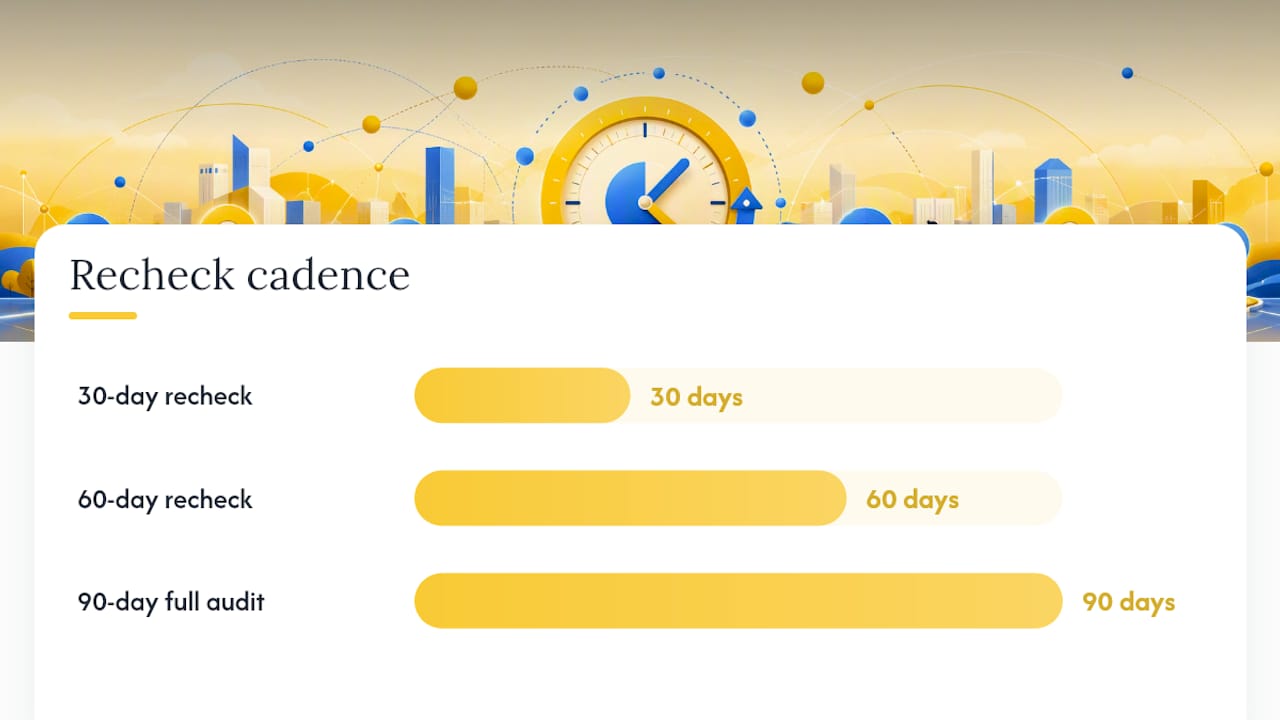
- Set 30-, 60-, and 90-day calendar reminders to recheck your top 10 listings.
- After 90 days, run a full audit tool scan to catch any aggregator re-pollution.
- Quarterly audits are the minimum cadence; monthly if you are in a competitive local market.
Timeline and cost ranges:
- DIY: 3–8 hours of your time for a single-location cleanup; ongoing monitoring is 1–2 hours per quarter.
- Citation cleanup service (one-time): typically $150–$500 depending on listing volume and number of duplicates.
- Ongoing managed citations: $50–$150/month through an agency or citation management platform.
Pro Tip: Your schema.org LocalBusiness telephone field should use callable format: "telephone": "+1-602-555-0100". This helps search engines parse the number reliably and avoids ambiguity between local and international formats.
For a broader view of how citation cleanup fits into your overall local SEO strategy, the work you do here compounds with on-page signals and review velocity.
How does call tracking affect your NAP, and what should you do about it?
Call tracking is one of the most common ways well-intentioned marketers accidentally damage their local signals. The problem is straightforward: if you replace your primary phone number with a tracking number on your Google Business Profile or key directories, you now have a different number appearing in different places, which looks like a mismatch to search engines.
AIOSEO’s guidance on phone formatting is clear: avoid placing tracking numbers as the public GBP number. The safe implementation pattern is to keep your canonical phone number on GBP, your website, and all directories, and use tracking numbers only in paid ad campaigns, where the number appears in the ad itself rather than in a directory listing.
Safe call-tracking practices:
- Use Dynamic Number Insertion (DNI) on your website for paid traffic only, not for organic visitors who land on your contact page.
- Never swap your GBP phone number for a campaign-specific tracking number, even temporarily.
- Route all tracking numbers to your main canonical line so callers always reach the right place.
- Document every tracking number in use, which campaign it belongs to, and its expiration date.
- Confirm your schema.org
telephonefield always shows the canonical number, not a tracking variant.
Pro Tip: If your marketing team runs Google Ads with call extensions, use a Google forwarding number within the ad platform itself. That keeps tracking data inside Google Ads without touching your GBP phone field.
What does a professional NAP cleanup actually look like?
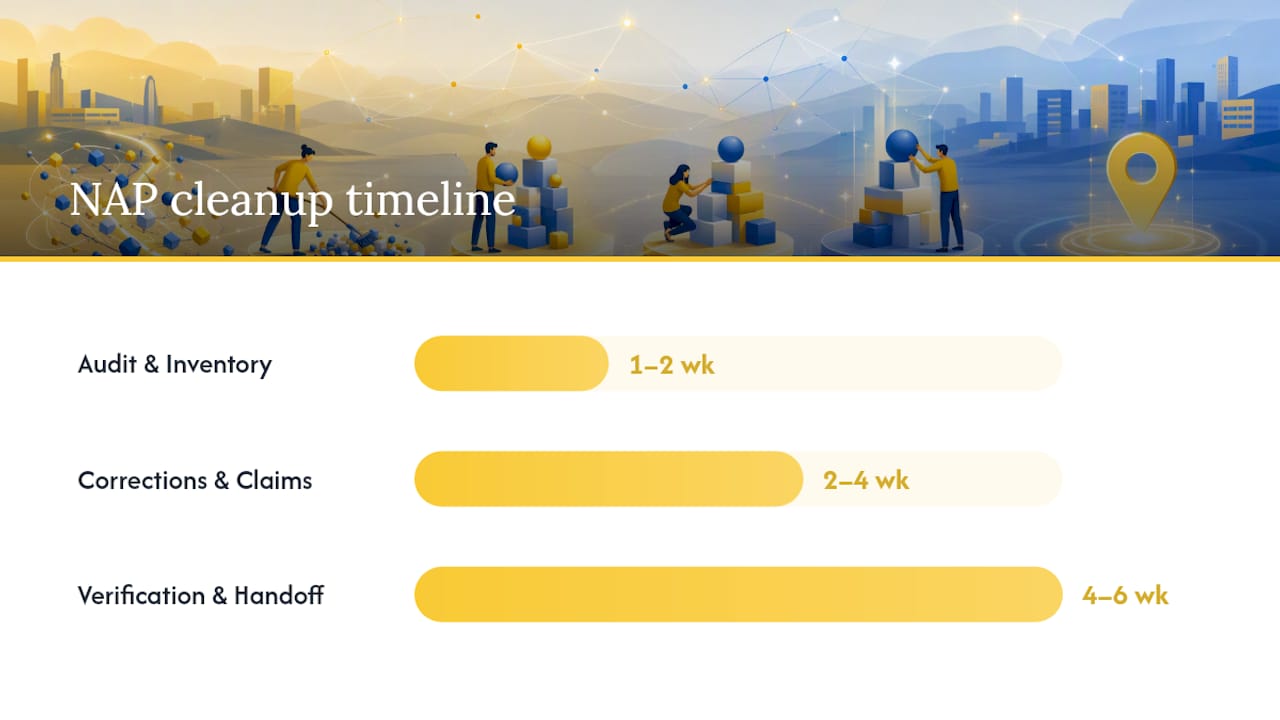
A structured agency engagement typically runs four to six weeks for a single-location business with moderate citation volume. Here is what the process looks like in practice.
Week 1–2: Audit and inventory
The agency runs automated scans across 40+ platforms, exports a master spreadsheet, and flags every mismatch by severity. Factual errors (wrong digits, old address) are marked critical; formatting variants are noted but deprioritized.
Weeks 2–4: Corrections and claims
The team claims unclaimed listings, submits corrections to data aggregators, and handles duplicate suppression requests. Schema markup is reviewed and updated on the client’s site.
Weeks 4–6: Verification and handoff
Each corrected listing is re-checked manually. The deliverables package includes the master spreadsheet with before/after values, claim URLs and login credentials, an update log with timestamps, and a propagation check report.
Expected outcomes:
- Improved local pack frequency, typically visible within 60–90 days as aggregator updates propagate.
- Cleaner GBP signals, which can lift map pack placement in competitive searches.
- Fewer misdirected calls and customers arriving at wrong addresses.
- A documented citation baseline that makes future audits faster.
Agencies also catch issues that DIY audits miss, particularly aggregator re-pollution, where a corrected listing reverts to old data because the upstream aggregator was never fixed. Businesses with multiple locations, recent moves, or name changes are especially vulnerable to this.
Pro Tip: Ask any agency you hire for the master spreadsheet and claim credentials at project close. You own that data, and you will need it for future audits regardless of who does the work.
For examples of measurable SEO improvements from structured local fixes, see Envisionmarketingagency’s long-term SEO outcomes and the common local SEO mistakes that compound citation problems.
Why NAP discipline is the foundation most businesses skip
Most local SEO conversations jump straight to reviews, content, and backlinks. Those things matter, but they sit on top of a foundation that has to be solid first. If Google cannot confidently verify where your business is and how to reach it, the reviews and content you accumulate carry less weight than they should.
What I see repeatedly with clients who have been doing local SEO for a year or more without results: their GBP looks fine, their reviews are decent, but somewhere in the background there are 15 directories showing an old suite number or a phone number from three years ago. The algorithm is not ignoring those signals. It is averaging them, and the average is noisy.
The priority sequence that actually moves the needle is this: canonical NAP on your website and schema first, GBP second, Apple Maps and Bing third, then industry directories. Reviews and content strategy come after that foundation is clean. Reversing the order is the most common mistake, and it is expensive in both time and lost leads.
Envisionmarketingagency handles your NAP cleanup from audit to verification
Envisionmarketingagency’s local SEO team in Phoenix does the full citation cleanup so you do not have to spend a weekend in spreadsheets. The process covers a 40-plus platform audit, manual corrections on your top directories, duplicate suppression, schema markup updates on your site, and a verification pass at 30 and 60 days. You get the master spreadsheet and all claim credentials at close, so you own the work permanently.
One-time citation cleanups typically run $200–$450 for a single-location business. Ongoing citation monitoring is available as part of a monthly local SEO retainer, which keeps your listings clean as aggregators refresh their data. For businesses that want the full picture, Envisionmarketingagency’s SEO services pair citation work with on-page optimization and review strategy.
Request a free citation audit at Envisionmarketingagency and get a platform-by-platform mismatch report within 48 hours.
Sources
These are the primary references to consult during your audit and for policy guidance: