

Most businesses pay between $15,000 and $80,000 for a website redesign in 2026, with strategy-led projects averaging $35,000 to $65,000. A basic refresh can run on the lower end of the cost spectrum, while a full enterprise rebuild can be quite expensive. Your next move: scope the project (pages, integrations, content volume) before requesting quotes, so vendors are bidding on the same job.
TL;DR:
- Most website redesigns in 2026 range from $15,000 to $80,000, with strategy-led projects often costing between $35,000 and $65,000.
- Project tiers vary from $1,000 to $8,000 for template refreshes to over $500,000 for enterprise replatforms, depending on scope and complexity.
- Key cost drivers include page count, customization, integrations, content migration, design complexity, and project timeline, which can significantly influence quotes.
- Accurate project budgeting requires breaking down costs by phases like discovery, design, development, and testing, with development often comprising 30-40% of the total.
- Proper scope definition, contingency planning, and phased delivery can help control costs and prevent scope creep and overlooked SEO risks.
Table of Contents
- How Much Does a Website Redesign Cost by Tier?
- What Actually Drives Your Website Redesign Price Up
- Where Your Redesign Budget Actually Goes (Phase by Phase)
- How to Budget for a Redesign and What Timeline to Expect
- Cutting Redesign Costs Without Cutting Corners
- Vendor Pricing Models: What Am I Actually Paying For?
- The Real Cost of Owning a Website After Launch
- Why Envision Marketing Agency’s Process Reduces Cost Risk
- The Two Mistakes That Blow Up Every Redesign Budget
- Ready to Scope Your Redesign the Right Way?
- Your Next Steps Before You Request Quotes
- Sources
How Much Does a Website Redesign Cost by Tier?
Your project falls into one of five tiers, and knowing which one you’re in before you call an agency saves you from comparing quotes that aren’t actually comparable. A $6,000 proposal and a $60,000 proposal aren’t competing bids. They’re answers to different questions.
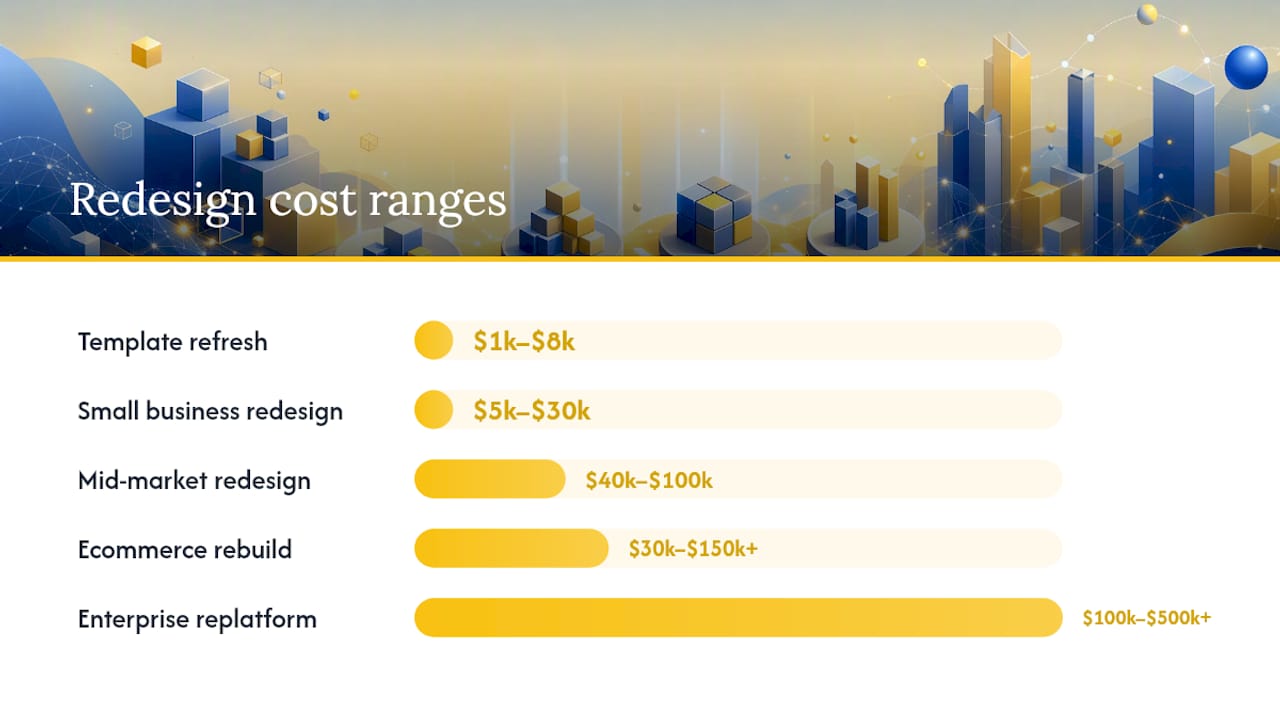
Template refresh ($1,000 to $8,000). This covers a new theme on an existing platform like WordPress or Squarespace, updated copy, and maybe a logo swap. No custom development, no new architecture. It works for a five-page consulting site or a local service business that needs to look current without rethinking anything structural.
Small business redesign ($5,000 to $30,000). This is where most independent businesses land. You get custom design (not a stock theme), a handful of unique page templates, basic SEO setup, and a content management system the team can actually update. Refact’s 2026 budget guide places SMB professional redesigns squarely in this range, and it lines up with what most agencies quote for a 10 to 20 page business site with light custom functionality.
Mid-market redesign ($40,000 to $100,000). Once you’re adding gated content, membership portals, multi-language support, or integrations with a CRM and marketing automation stack, costs climb fast. This tier usually includes a proper discovery phase, a design system rather than one-off pages, and development work across front end, back end, and third-party APIs.
Ecommerce rebuild ($30,000 to $150,000+). Ecommerce sits on its own axis because catalog size, payment integrations, inventory syncing, and checkout customization all add cost independent of page count. A 200-SKU store with a straightforward Shopify build costs far less than a 10,000-SKU catalog needing custom filtering and ERP integration.
Enterprise replatform ($100,000 to $500,000+). Full platform migrations, headless CMS architecture, multi-brand sites, and compliance-heavy builds (healthcare, finance, legal) live here. Launch Day Advisors reports that design-only totals for strategy-led projects run $33,000 to $76,000, with design plus development frequently reaching $50,000 to $150,000 or more once you factor in full build scope.
A few things move a project between bands regardless of company size:
- A tight launch deadline pushes a small-business project into mid-market pricing because rushed timelines require more staff hours concentrated into less time.
- Heavy content migration (thousands of blog posts, product pages, or legacy PDFs) can add 20 to 40 percent to a quote that otherwise looks like a straightforward redesign.
- Accessibility compliance requirements (WCAG 2.1 AA, for example) add QA and development hours that a generic quote often doesn’t include.
What Actually Drives Your Website Redesign Price Up
Two businesses with the same page count can get wildly different quotes, and the gap almost never comes from the agency padding their number. It comes from five variables that most business owners underestimate until they’re deep into a project.
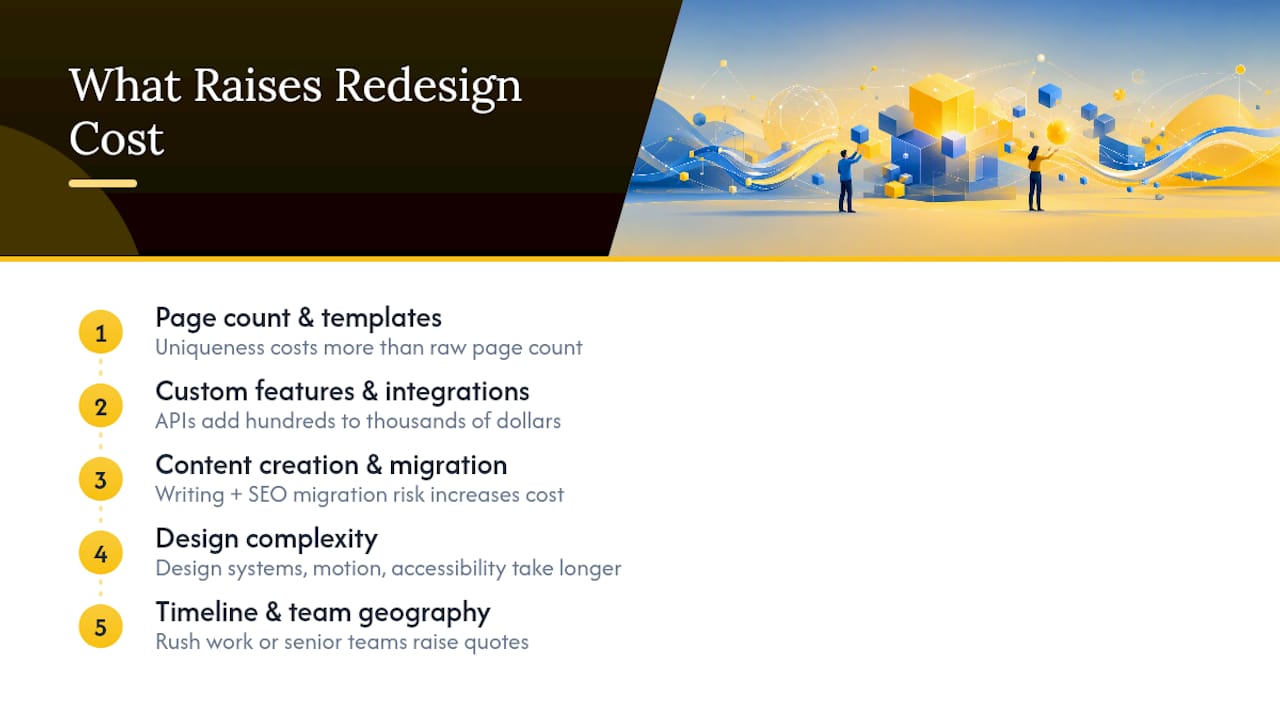
Page count and unique templates. A 50-page site built from three repeating templates costs less than a 20-page site where every page needs a custom layout. Agencies price by design hours, not page count, so uniqueness matters more than volume.
Custom features and integrations. A contact form is cheap. A CRM-connected lead capture system with conditional logic, a customer portal with login authentication, or an ecommerce checkout tied to a legacy inventory system are not. Each integration point is a separate technical conversation, and each one can add anywhere from a few hundred to several thousand dollars depending on how well-documented the third-party API is.
Content creation and migration. Writing new copy for 15 pages from scratch costs more than reformatting existing copy, and reformatting existing copy costs more than a straight lift-and-shift migration. The risk multiplies when migration touches SEO. Move a URL structure without proper redirects and you can tank organic traffic that took years to build. This is one of the most underpriced risks in the entire redesign process, and it’s worth reading how conversion rate optimization work interacts with redesign decisions before you finalize a new site map.
Design complexity. A polished design system with documented components, motion design, and full accessibility compliance takes longer to build than a one-off visual style, but it pays off across every future page you add. Skipping it saves money upfront and costs more the second time you need a new landing page.
Timeline and team geography. Rushed projects cost more because they require overtime or parallel work streams that would normally happen sequentially. Team location matters too: a freelancer working solo will typically quote less than a small agency, and a small agency will typically quote less than a firm staffed with dedicated strategists, designers, and developers working in tandem.
Pro Tip: Ask every vendor to break out their quote by the five drivers above, not just by phase. If a proposal can’t tell you how much of the number comes from custom integrations versus content work, you can’t negotiate intelligently, and you can’t tell if they’ve priced the SEO migration risk at all.
Where Your Redesign Budget Actually Goes (Phase by Phase)
A proposal that lists one lump number is a red flag. A legitimate quote breaks the project into phases, and each phase should carry a predictable share of the total.
- Discovery and strategy (10 to 15 percent). Stakeholder interviews, competitive audits, technical audits of the existing site, and goal setting. Skip this and you’re paying a designer to guess at your business objectives.
- Information architecture and wireframes (10 to 15 percent). Site mapping, user flow diagrams, and low-fidelity wireframes that get signed off before anyone touches visual design. This is the cheapest phase to iterate on and the most expensive phase to skip.
- Visual design and design system (20 to 30 percent). High-fidelity mockups, a component library, brand application across templates. On larger projects this is where the biggest single chunk of budget lands.
- Development, including front end, back end, CMS setup, and integrations (30 to 40 percent). The largest phase on almost every project, and the one most likely to run over budget when custom features weren’t scoped precisely during discovery.
- QA, testing, and launch (5 to 10 percent). Cross-browser and cross-device testing catches the bugs that otherwise surface after launch, when they’re far more expensive to fix. TestGrid’s guidance on cross-browser testing makes the case plainly: issues caught in QA cost a fraction of what the same issues cost once real customers hit them.
- Project management and handoff (5 to 10 percent). Coordination, client communication, training on the new CMS, and documentation for future updates.
These percentages hold up across most tiers, though enterprise projects often push development closer to 45 percent because integration complexity scales faster than design work. If a proposal quotes 60 percent of the total for development and nothing for discovery, that’s usually a sign the vendor is skipping the strategy work that keeps a redesign from missing its business goals entirely.
How to Budget for a Redesign and What Timeline to Expect
Timelines track roughly with cost tier, and knowing the expected duration helps you spot a proposal that’s either unrealistically fast or padded with unnecessary buffer.
- Template refresh: 2 to 6 weeks. Minimal custom work means minimal back and forth.
- Small business or mid-market redesign: 8 to 16 weeks. Discovery, design rounds, development, and QA each need dedicated time, and stakeholder review cycles are usually the bottleneck, not the build itself.
- Ecommerce or enterprise rebuild: 3 to 9+ months. Integration testing, data migration, and phased rollouts (especially for large catalogs) stretch timelines regardless of team size.
A simple way to set your working budget: take your best available comparable (the tier ranges above), multiply the midpoint by your page count relative to a typical project in that tier, then add a contingency of 10 to 20 percent for scope changes that surface once development starts. That contingency isn’t pessimism. It’s the buffer that keeps a discovered integration requirement or a late content delay from blowing up the whole project.
Before requesting quotes, prepare:
- A rough site map with page count and page types
- A list of required integrations (CRM, payment processor, email platform)
- Existing analytics data showing your top-performing pages, so nothing valuable gets lost in the redesign
- Internal approval chains mapped out, since stakeholder review delays are the single most common reason redesign timelines slip
Cutting Redesign Costs Without Cutting Corners
Every cost-saving tactic comes with a trade-off. The goal isn’t to avoid trade-offs. It’s to choose them on purpose instead of discovering them after the invoice arrives.
- Theme customization instead of custom design cuts cost significantly and gets you live faster, but you’re constrained by what the theme’s structure allows. Fine for a services business, risky for a brand that depends on visual differentiation.
- Phased delivery (an MVP-first approach) launches the core site now and adds features like a customer portal or advanced filtering in a second phase. Refact’s research points to this approach producing better ROI because you’re prioritizing spend around what actually moves the business, rather than building everything at once and hoping it all matters equally.
- AI-assisted design and content tools speed up first drafts of copy and layout concepts, and platform-based rebuilds using AI-assisted workflows can run 30 to 50 percent cheaper than full custom agency work for straightforward sites. The trade-off shows up on conversion-critical pages, where AI-built landing pages still need human strategy behind them to actually convert.
- No-code platforms work well for simple marketing sites and poorly for anything requiring deep customization or complex data relationships.
Pro Tip: Put scope governance in writing before development starts: a one-page document listing exactly what’s in the build and what counts as a change order. This single habit prevents more budget overruns than any negotiation tactic.
Vendor Pricing Models: What Am I Actually Paying For?
Redesign proposals come in four structures, and mixing them up when comparing bids is how businesses end up choosing the wrong vendor for the wrong reason.
- Fixed price quotes a single number for defined deliverables. Best when scope is well understood upfront.
- Time and materials bills hourly or by sprint. Better for projects where scope will evolve, but it requires more active client oversight to control costs.
- Retainers cover ongoing work (redesign plus continued updates) under a monthly fee. Common for businesses pairing a redesign with continued marketing support.
- Subscription or platform pricing bundles hosting, templates, and support into one recurring fee, typically for DIY or lighter-touch builds.
To compare proposals fairly:
- Normalize each quote to the same scope document, not each vendor’s own assumptions.
- Ask what happens to ownership of the code, design files, and content if the relationship ends.
- Confirm warranty terms: how many days of post-launch bug fixes are included at no charge.
- Ask about rollback plans if the new site underperforms the old one.
- Request a support SLA in writing, not a verbal promise.
Checking a vendor’s marketplace listings or certified partner status is a reasonable shortlist signal, though it should never replace an actual reference check with a past client.
The Real Cost of Owning a Website After Launch
The redesign invoice is not the last check you write. Budget 15 to 30 percent of your build cost annually for maintenance and iterative improvements, a range both major 2026 pricing guides converge on. Over three years, total cost of ownership often runs close to double the initial build price once you factor in:
- Hosting, CDN, and SSL costs, which scale with traffic and typically run a few hundred to a few thousand dollars a year depending on tier
- Security monitoring and patching, worth the investment given how costly a breach becomes once you factor in the reported financial impact of security incidents
- SEO remediation if the launch causes a traffic dip from redirect errors or lost backlinks
- Ongoing licensing for CMS plugins, integrations, or platform subscription tiers
Enterprise builds tend to skew opex-heavy (ongoing subscription and hosting fees), while custom-built sites on owned infrastructure shift more cost to the upfront capital side. Neither is inherently cheaper. They just distribute the spend differently across your budget cycle.
Why Envision Marketing Agency’s Process Reduces Cost Risk
Every project runs through discovery, strategy, design, build, launch, and iteration, in that order, with no phase skipped to save time. Since 2020, Envisionmarketingagency has worked with more than 550 clients, treating scope discipline and SEO-safe migration planning as core deliverables rather than add-ons. Transparent, phase-by-phase estimates mean fewer surprise change orders and a clearer line between what you’re paying for and what it produces.
The Two Mistakes That Blow Up Every Redesign Budget
Scope creep and skipped SEO migration planning are the two costs I see catch businesses off guard most often. A client adds “just one more feature” mid-build, or nobody maps old URLs to new ones before launch, and traffic drops for months. The fix is boring but reliable: freeze scope after discovery, and hold a 10 percent contingency you don’t touch unless the change is genuinely necessary.
— Marcus
Ready to Scope Your Redesign the Right Way?
This agency runs redesigns discovery-first, which means you get a real scope document and a transparent, phase-by-phase estimate before any design work starts, not a generic quote pulled from a price sheet. That approach protects the SEO equity your current site has already earned while giving you a build that’s priced against your actual pages, integrations, and content, not a rough guess.
A first call typically covers your current site’s technical health, your priority integrations, and a realistic timeline based on your tier, whether that’s a small business refresh or a full ecommerce rebuild. You’ll leave with a clear breakdown of deliverables and cost, not a sales pitch. If you’re ready to see what a redesign scoped around your business actually costs, start with Envisionmarketingagency’s custom web development portfolio and request a discovery call.
Your Next Steps Before You Request Quotes
Before contacting any vendor, write down your goals, page count, required integrations, and the KPI targets you want the new site to hit (lead volume, conversion rate, page speed).
- Draft a one-page RFP that lists page count, integrations, content responsibilities, timeline, and budget range, so vendors bid on identical scope.
- Require every vendor to quote by phase (discovery, design, development, QA, PM), not as one lump figure.
- Score proposals on a simple matrix: price, proven outcomes (case studies or references), timeline realism, and post-launch support terms, weighted by what matters most to your business.
- Choose the vendor whose scope document matches your RFP most closely, not necessarily the lowest number. A cheap quote missing SEO migration planning usually costs more in the long run than a properly scoped one.
Sources
- Website Redesign Cost: 2026 Buyer’s Guide | Launch Day Advisors
- Website Redesign Cost: 2026 Budget Guide | Refact
- Free Website Redesign Cost Calculator (2026) | Revamp