

BLUF: a landing page is a single-goal page built for one conversion action; a homepage is your multi-goal hub built for exploration and brand credibility. If you’re paying for traffic (Google Ads, a promo email, a Facebook campaign), send it to a landing page. If someone is discovering your brand organically or typing your name into a search bar, your homepage should do the work.
That’s the rule of thumb almost every serious marketer settles on, and it holds up because the two pages are built to answer different questions. A landing page answers “should I do this one thing right now?” A homepage answers “what is this business, and where do I go next?”
Two things to do this week:
- Audit your current PPC campaigns. Open your ad manager and check where every campaign actually points. If more than a handful land on your homepage instead of a dedicated page, you’re likely losing conversions to distraction.
- Check your homepage’s primary call to action. It should orient visitors toward your best next step (a demo, a catalog, a contact form), not compete with five equally loud buttons.
Key Takeaways
Send paid and campaign traffic to a dedicated landing page and let your homepage handle organic discovery, brand credibility, and long-term SEO.
| Point | Details |
|---|---|
| Match page to traffic source | Paid ads and email promotions go to landing pages; organic and direct traffic go to the homepage. |
| One CTA wins on campaigns | Landing pages convert better when navigation is stripped and one action repeats down the page. |
| Wait for real sample size | Trust A/B test results only after several hundred conversions per variant accumulate. |
| Audit before you scale spend | Check headline match, CTA count, navigation, mobile speed, and tracking before launching a campaign. |
| Get pages built around lead quality | Envisionmarketingagency designs landing pages and homepages using qualified-lead data, not just traffic volume. |
Table of Contents
- Landing Page vs Homepage: Clear Definitions and a Quick Comparison
- What Actually Separates a Landing Page From a Homepage
- When to Use a Landing Page vs When to Rely on Your Homepage
- Landing Page and Homepage Anatomy: What Belongs on Each
- How to Measure and Test Each Page Type
- The Mistakes That Quietly Waste Ad Spend
- Mapping Landing Pages and Homepages Into a Real Funnel
- Why Envisionmarketingagency’s Track Record Matters Here
- The Real Tradeoff Nobody Talks About
- Get a Page Built for the Job, Not a Generic Template
- Frequently Asked Questions
- Sources
Landing Page vs Homepage: Clear Definitions and a Quick Comparison
A landing page is a standalone page built for a single marketing purpose with one call to action and no distractions. It exists to convert a specific type of visitor who arrived with a specific intent, usually from an ad, an email link, or a QR code on a flyer.
A homepage is the front door of your website. It’s a multi-page hub designed for exploration, meant to serve dozens of different visitor intents at once, from someone comparing vendors to a returning customer looking for a support link.
Here’s how the two stack up on the attributes that matter most:
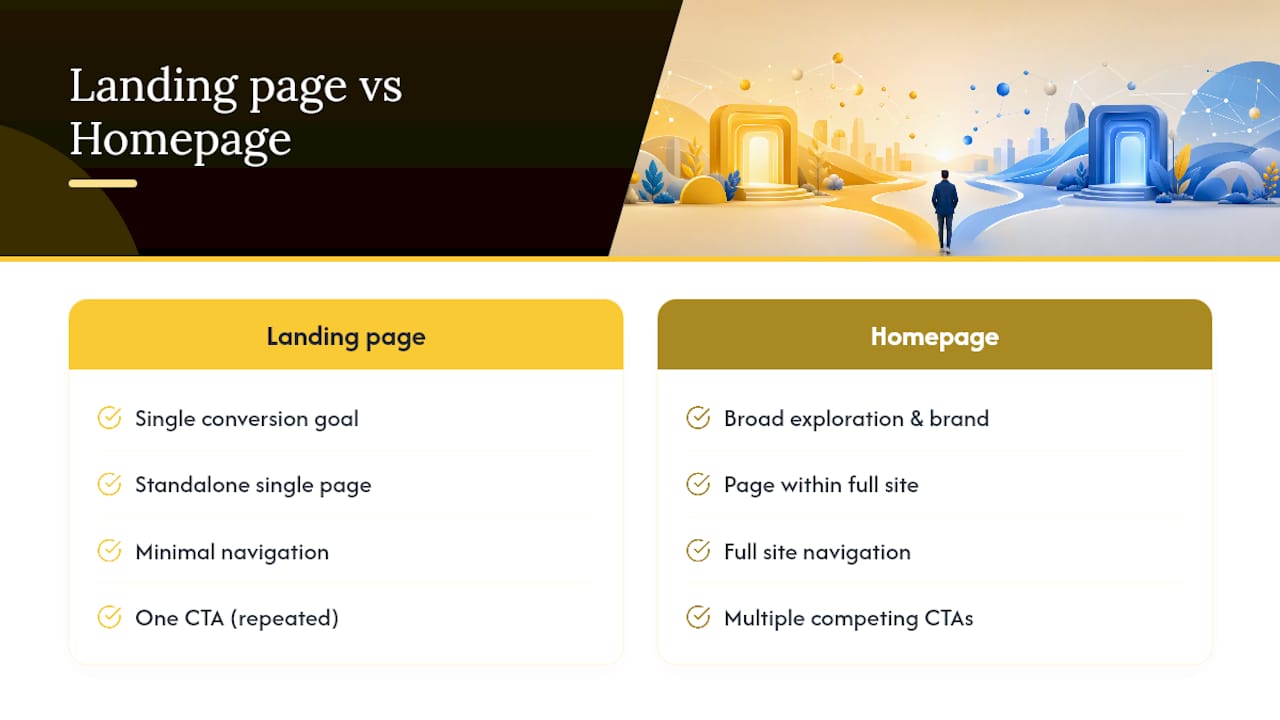
| Attribute | Landing Page | Homepage |
|---|---|---|
| Number of pages | One | Part of a multi-page site |
| Navigation | Stripped down or removed | Full menu, footer, search |
| Primary CTA | One action, repeated | Several competing actions |
| Typical lifespan | Weeks to months (campaign-tied) | Years, with ongoing updates |
| Traffic source | Paid ads, email, social promos | Organic search, direct, referral |
A few edge cases sit between these two categories. Microsites, for instance, are small multi-page sites built around a single campaign or product launch. They behave like a cluster of landing pages that share a navigation shell, which makes them useful when one offer needs more than a single screen to explain. Single-page sites for solo consultants or early-stage startups are another gray zone. They technically function as a homepage but often carry landing-page discipline: one message, one CTA, minimal wandering.
What Actually Separates a Landing Page From a Homepage
The differences go deeper than page count. Five factors determine which one you need for a given campaign or business goal.
- Goal and purpose. A landing page exists to drive one conversion: a signup, a purchase, a booked call. A homepage exists to orient a visitor toward the right next step among many, whether that’s browsing products, reading your story, or finding a phone number.
- Traffic intent. People clicking a landing page usually arrived already primed. They saw an ad promising a specific outcome and clicked because that outcome interested them. Homepage visitors are more mixed. Some are ready to buy, some are researching competitors, some just want your address.
- Navigation as friction or feature. On a landing page, a full navigation menu is often a liability. Every link is an exit ramp away from the one action you want. On a homepage, that same navigation is the feature. It’s how a first-time visitor finds the pricing page, the blog, or your careers section.
- Content scope and CTA strategy. Landing pages go deep on one offer with one CTA repeated at intervals. Homepages go wide, covering multiple products or services with multiple CTAs pointing to different destinations.
- Lifespan. A landing page tied to a spring sale or a webinar has a natural expiration date. A homepage is closer to permanent infrastructure. You’ll redesign it every few years, but you won’t delete it after a campaign wraps.
Landing pages typically convert better than homepages for targeted campaigns because removing navigation and competing links focuses the visitor on a single decision. That single-choice environment is the entire reason dedicated campaign pages outperform generic ones. It’s not about better design. It’s about fewer ways for someone to leave.
When to Use a Landing Page vs When to Rely on Your Homepage
The decision usually comes down to one question: are you promoting a specific offer, or are you inviting general exploration?
Build a landing page when you’re running:
- A paid ad campaign (Google Ads, Meta, LinkedIn) tied to one specific offer
- An email promotion announcing a sale, webinar, or limited-time discount
- An event registration page for a conference, workshop, or open house
- A product launch that needs its own conversion-focused pitch
- A quick market test to see whether an idea or offer has demand before you build it out fully
Rely on your homepage when the goal is:
- Establishing brand credibility for someone hearing about you for the first time
- Showcasing a full product catalog or service menu
- Housing a service overview that needs to serve several different buyer types
- Acting as the hub for your SEO content, linking out to blog posts, case studies, and category pages
Startups face this decision earlier than most. A common and smart path is to validate an idea using nothing but a landing page, collecting signups or pre-orders before investing in a full multi-page site. Once the offer proves itself and the business needs to support multiple products, content types, or customer segments, that’s the signal to build out a proper homepage and site architecture.
Before launching either, run through these questions:
- What’s the single action I want this visitor to take?
- Did this traffic arrive already knowing what I’m offering, or does it need context first?
- Will this page still be relevant in six months, or is it tied to a specific campaign window?
- Do I need this to rank in organic search, or is it purely a conversion tool for paid traffic?
Pro Tip: If you’re not sure which one you need, ask what happens if the visitor clicks “back.” On a landing page, that should feel like abandoning a specific offer. On a homepage, it should feel like leaving a store, not a single aisle.
Landing Page and Homepage Anatomy: What Belongs on Each
Building the wrong elements into the wrong page is one of the fastest ways to tank a campaign’s performance. Each page type has a different job, so the components need to match.
A landing page built to convert needs a clear headline stating the value proposition in one sentence, followed immediately by supporting copy that answers the visitor’s implicit “why should I care?” From there:
- One CTA button, repeated two or three times down the page as the visitor scrolls
- Social proof placed close to the CTA (testimonials, client logos, review counts)
- Minimal exit links. No header navigation, no footer full of unrelated pages
- A form or purchase flow that asks for only what’s necessary to convert
A homepage carries more weight and more visitors with different needs, so its anatomy looks different:
- A hero section that communicates brand identity fast, ideally in under five seconds of scanning
- Multiple CTAs pointing to different paths (shop now, learn more, book a consultation)
- A full navigation bar giving access to every major section of the site
- Trust signals and longer-form content sections that build credibility over a longer visit, not a single glance
Both pages share non-negotiable technical priorities: page speed, responsive layout on mobile, and forms that validate input in real time instead of throwing an error after submission. A landing page that loads slowly on mobile bleeds conversions before the visitor ever reads your headline. Instapage’s comparison of homepage and landing page design makes a similar point: keeping the ratio of links to CTAs low on a campaign page measurably improves focus and follow-through.
Pro Tip: Swap out generic stock photography on landing pages for images that show the actual product or outcome. A screenshot of your dashboard converts better than a smiling stock model every time, because it answers a real question instead of decorating the page.

If you want a deeper walkthrough of building landing pages that hold up under real ad spend, Envisionmarketingagency’s guide on using AI to build converting landing pages breaks down the process step by step.
How to Measure and Test Each Page Type
Landing pages and homepages get judged by different numbers, and mixing up the scorecards leads to bad decisions.
- Track landing page KPIs separately. Conversion rate, cost per lead or cost per acquisition, and lead quality (not just lead volume) are the three numbers that matter. A median landing page conversion rate benchmark cited across the industry sits in the mid-single digits, but treat that as a rough compass, not a target. Your actual rate depends heavily on offer strength, audience temperature, and channel.
- Respect sample size before trusting an A/B test. For landing page tests, aim for at least several hundred conversions per variant before calling a winner. Below that, you’re often reacting to noise, not a real difference in performance.
- Track homepage KPIs on a different timeline. Organic keyword rankings, assisted conversions (visits that influence a sale without being the last click), overall engagement, and how quickly a new visitor finds a meaningful next step all matter more here than a single conversion rate.
- Prioritize A/B tests that move the needle. Headline wording, CTA button copy and color, and form length consistently produce the biggest lifts on landing pages. Test one variable at a time so you know what actually caused the change.
- Fix your attribution before you scale spend. Sending paid traffic to a homepage instead of a dedicated landing page tends to dilute performance data because you can no longer cleanly tie a conversion to a specific ad, keyword, or audience segment. That confusion compounds as you add more campaigns.
If lead handoff between your ad platform and your sales team feels messy, a tool built for lead capture and CRM syncing can close that gap so conversions on your landing page don’t stall out before they reach a rep.
The Mistakes That Quietly Waste Ad Spend
Most conversion problems trace back to a small handful of repeatable errors.
- Sending paid traffic to a homepage that doesn’t match the ad’s specific offer or creative
- Cramming a campaign landing page with the full site navigation, giving visitors five ways to leave before they convert
- Skipping event tracking, so you can’t tell which headline or CTA variant actually drove results
- Shipping a form with no real-time validation, so users abandon it after a confusing error
- Ignoring mobile load times, which quietly kills conversions before the page even finishes rendering
Run this quick audit before your next campaign goes live:
- Does the landing page headline match the ad copy word for word, or close to it?
- Is there exactly one CTA, and does it repeat at least twice on longer pages?
- Is navigation removed or reduced to a bare minimum?
- Does the page load in under three seconds on a mobile connection?
- Is conversion tracking firing correctly before you spend a single dollar on traffic?
Any “no” on that list is a red flag worth fixing before launch, not after the budget’s spent.
Mapping Landing Pages and Homepages Into a Real Funnel
The strongest setups treat landing pages and homepages as connected stages, not competing options.
- Ad or email click lands the visitor on a dedicated landing page matching that specific offer.
- Conversion event (form fill, purchase, signup) routes to a thank-you page that confirms the action and sets expectations for what happens next.
- Nurture sequence follows up by email, gradually introducing the visitor to your broader catalog or content, often linking back to your homepage or a funnel offer built specifically for that stage.
- Long-term relationship shifts to your homepage and site as the primary touchpoint once the visitor is a known contact rather than a cold click.
Use microsites when one campaign genuinely needs several connected pages (a product launch with a demo, pricing, and FAQ). Stick with single landing pages when the offer is simple. For SEO, canonicalize duplicate or near-duplicate landing pages back to a primary version, and keep local landing pages unique per location with distinct content and proof, rather than swapping out just a city name on an identical template.
Why Envisionmarketingagency’s Track Record Matters Here
Getting this decision wrong is expensive, which is why it’s worth listening to an agency that’s made it correctly hundreds of times. Envisionmarketingagency has served over 550 clients since 2020, building both campaign landing pages and full homepage redesigns across professional services, e-commerce, healthcare, legal, and startup clients.
The recurring pattern across those projects: businesses sending Google Ads traffic straight to a cluttered homepage, wondering why cost per lead kept climbing. Rebuilding a single, focused landing page around the exact ad offer, then measuring qualified leads instead of raw click volume, consistently brought that cost back down and improved the quality of leads reaching sales.
That data-driven emphasis, tracking qualified leads over vanity traffic numbers, is the core of how Envisionmarketingagency approaches every landing page and homepage build.
The Real Tradeoff Nobody Talks About
Most guides frame this as a technical distinction. It’s really a budget and speed decision disguised as a technical one.
A templated landing page gets a campaign live in days and tells you fast whether an offer has legs. A custom-built page, or a full homepage rebuild, takes longer and costs more, but it compounds in SEO value and brand equity over years. The mistake I see most often isn’t picking the wrong page type. It’s picking the right one, then treating it like a permanent decision instead of testing it fast and iterating.
If you’re unsure which route your next campaign needs, run a quick landing page test before committing budget to a full site section.
Get a Page Built for the Job, Not a Generic Template
Envisionmarketingagency builds both sides of this equation: dedicated, conversion-focused landing pages for campaigns that need to perform immediately, and full homepage and site redesigns for businesses ready to scale their brand presence long term. The difference from hiring a generalist freelancer or piecing it together yourself is that every page gets built around actual lead-quality data, not just traffic volume, so you’re not guessing which version of a headline or CTA is costing you conversions.
Whether you need a single high-converting landing page for an upcoming launch or a homepage that finally reflects what your business actually does, Envisionmarketingagency’s custom website design services start with an audit of your current pages and traffic sources. If you’re still deciding between a targeted campaign page or a broader site investment, request a page audit and get a specific recommendation instead of a generic template pitch. You can also explore custom web development built for scale if your next step is a full homepage rebuild rather than a single campaign page.
Frequently Asked Questions
Is a landing page the same as a homepage?
No. A landing page is a single, standalone page built around one conversion goal, while a homepage is one page within a larger multi-page site designed for broad exploration and brand presence.
Can a landing page replace a homepage entirely?
For early-stage validation, yes. Many startups run on a single landing page while testing demand before investing in a full site. Once you’re managing multiple products, content types, or customer segments, a full homepage and site structure becomes necessary.
Should I ever send Google Ads traffic to my homepage?
Generally, no. Homepages carry navigation and competing messages that pull attention away from the specific offer your ad promised, and they make it harder to attribute conversions cleanly back to that campaign.
How many CTAs should a landing page have?
One. It can repeat two or three times as the visitor scrolls, but every instance should point to the same action to avoid splitting attention.
What’s the difference between a landing page and a service area or city landing page?
The core structure is the same, single goal, minimal navigation, but city or service area landing pages need unique local content, proof points, and details specific to that location rather than a swapped city name on an identical template.
Sources
For readers who want to go further, HubSpot’s breakdown of landing pages versus websites covers definitions and use cases in more depth. Unbounce’s comparison is a solid reference for testing practices and sample size guidance. Instapage’s anatomy breakdown walks through concrete conversion examples, and AWeber’s comparative guide offers a practical checklist for businesses still deciding which page to build first.
- Landing Page vs. Website: What’s the Difference? + How to Choose
- Landing page vs homepage vs website: What’s the difference?
- Landing Page vs. Homepage: What’s the Difference?