

A B2B LinkedIn program built around account-focused targeting, Sponsored Content (single image plus Thought Leader Ads), short-form video, and LinkedIn Lead Gen Forms will reliably feed pipeline when it’s instrumented with CRM sync and multi-touch attribution. That’s the short answer. Everything below is the how.
Your three launch actions:
- Define your ICP and upload a target account list into LinkedIn Campaign Manager using Matched Audiences.
- Create one top-of-funnel Sponsored Content creative (single image) and boost one Thought Leader post from a company executive or subject-matter expert.
- Set up a Lead Gen Form connected to your CRM and install the LinkedIn Insight Tag with UTM conventions before spending a dollar.
Pro Tip: Duplicate your best-performing ad instead of creating a new one from scratch. LinkedIn preserves social proof (likes, comments, shares) on duplicated ads, which accelerates early learning and keeps engagement signals intact while you test new audiences.
Envisionmarketingagency runs this exact structure for B2B clients across industries. The sections below walk through every layer: formats, campaign structure, targeting, creative, bidding, measurement, and the experiments worth running now.
Key Takeaways
A B2B LinkedIn program generates measurable pipeline when it combines account-focused targeting, format discipline, CRM-connected measurement, and a consistent testing cadence from day one.
| Point | Details |
|---|---|
| Account-first targeting | Upload CRM account lists via Matched Audiences and layer job title, seniority, and company size on top for ICP precision. |
| Format priorities | Lead with single-image Sponsored Content and Thought Leader Ads; add short-form video as a mid-funnel test within the first 60 days. |
| Measurement requirements | Install the LinkedIn Insight Tag, set UTM conventions, connect Lead Gen Forms to your CRM, and report on pipeline influenced monthly. |
| Budget expectations | Start at $3,000–$5,000 per month for a pilot; scale in 20% weekly increments only after CPL and SQL rate are stable for three consecutive weeks. |
| Scaling signals | Stable CPL trend, consistent SQL rate, and buying group coverage across target accounts are the three indicators a campaign is ready to scale. |
| Envisionmarketingagency | Offers campaign audits, 60-day pilot programs, and managed retainers that connect LinkedIn ads to CRM pipeline reporting for B2B clients. |
Table of Contents
- Which LinkedIn ad formats work best for B2B goals?
- How to structure campaigns in LinkedIn Campaign Manager
- B2B targeting strategies that actually move the needle
- Creative and copy that converts B2B audiences
- Bidding, budgets, and optimization routines
- How to measure LinkedIn ad performance and tie it to pipeline
- How to scale LinkedIn campaigns and avoid common mistakes
- Agency-tested experiments worth running now
- How LinkedIn Audience Insights sharpens your targeting
- Integrating LinkedIn campaigns with other marketing channels
- Frequency capping and managing ad fatigue in B2B
- Budget allocation across campaigns and phases
- What actually works: an editorial perspective on B2B LinkedIn ads
- Envisionmarketingagency’s approach to B2B LinkedIn ad strategy
- Sources
Which LinkedIn ad formats work best for B2B goals?
LinkedIn offers more ad formats than most B2B teams use, and the gap between “available” and “worth running” is real. According to LinkedIn’s own format documentation, the core formats for B2B advertisers are Sponsored Content (single image, carousel, video, document), Thought Leader Ads, Message Ads, Conversation Ads, Text Ads, and Dynamic Ads.
Here’s how to match format to funnel stage:
- Sponsored Content (single image): Best for cold awareness. Low production cost, fast to test, and the workhorse of most B2B programs.
- Video Ads: Mid-funnel education. A 30–60 second video that explains a problem or outcome outperforms a product demo at this stage.
- Document Ads: Evaluation stage. Whitepapers, frameworks, and playbooks work well here. Readers can flip through pages in-feed without leaving LinkedIn.
- Thought Leader Ads: Engagement and trust-building. Boost a post from a named executive or practitioner rather than the company page. Factors notes these consistently outperform company-page posts for engagement and mid-funnel depth when paired with account-based audiences.
- Conversation Ads / Message Ads: Personalized outreach to warm audiences. High CPM, so reserve these for retargeting or ABM lists where you know the contact is relevant.
- Lead Gen Forms: Attach to Sponsored Content or Message Ads at the conversion stage. Pre-filled profile data reduces friction significantly.
Lead Gen Forms vs. landing pages: Forms win on conversion rate because LinkedIn pre-fills name, title, company, and email from the member’s profile. Landing pages win on data richness and post-click experience. Use forms for top-of-funnel lead volume; use landing pages when you need qualifying behavior (scroll depth, time on page, multi-step forms) or when your offer requires context a form can’t provide. Sprout Social’s LinkedIn ads guide recommends testing both in parallel before committing budget to one.
Pro Tip: Test Thought Leader Ads and short-form video (under 30 seconds) in the same campaign period. Run each for two weeks minimum before drawing conclusions. Short-form video often wins on CPL; Thought Leader Ads often win on downstream engagement quality.
| Format | Best Funnel Stage | Production Effort | Primary B2B Use Case |
|---|---|---|---|
| Single Image Sponsored Content | Awareness | Low | Brand and offer introduction |
| Video Ad | Consideration | Medium | Problem/solution education |
| Document Ad | Evaluation | Medium | Gated content, frameworks |
| Thought Leader Ad | Engagement/Trust | Low | Executive credibility |
| Conversation/Message Ad | Retargeting/ABM | Low | Personalized outreach |
| Lead Gen Form | Conversion | Low | Lead capture |
How to structure campaigns in LinkedIn Campaign Manager
Account structure is where most B2B programs quietly fail. Mixing cold audiences, retargeting, and ABM lists inside one campaign makes optimization impossible because LinkedIn’s algorithm can’t learn cleanly across wildly different intent levels.
Recommended structure:
- Cold/Awareness campaigns: One campaign per ICP segment (e.g., VP of Sales at SaaS companies, 200–1,000 employees). Single image or short-form video. Objective: Brand Awareness or Engagement.
- Nurture/Retargeting campaigns: Separate campaign targeting website visitors, video viewers (25%+), or Lead Gen Form openers. Objective: Lead Generation or Website Conversions.
- ABM campaigns: One campaign per named account cluster or buying group. Matched Audiences + personalized creative. Objective: Lead Generation or Engagement.
Objective selection rules:
- Use Brand Awareness when you have no conversion data and need impression volume.
- Use Engagement for Thought Leader Ads and content distribution where clicks aren’t the primary goal.
- Use Lead Generation when you have a Lead Gen Form ready and a CRM connector live.
- Use Website Conversions when you have the Insight Tag installed and at least 300 conversions in the window LinkedIn needs to optimize.
Naming convention example: [Stage]_[Audience]_[Format]_[Date] — e.g., Cold_VPSales_SaaS_SingleImage_2026Q2. This makes reporting and duplication fast.
Pre-launch checklist:
- LinkedIn Insight Tag installed and firing on all key pages.
- UTM parameters set for every ad URL (source=linkedin, medium=paid, campaign=[name]).
- Lead Gen Form assets created and mapped to CRM fields.
- At least two creative variations per ad group.
- Account permissions confirmed (Campaign Manager admin access for all team members who need it).
Pro Tip: Never mix audience types (cold, retargeting, ABM) in the same campaign. LinkedIn’s delivery algorithm will favor the largest audience segment and starve the others, skewing your results.
B2B targeting strategies that actually move the needle
LinkedIn’s targeting precision is genuinely unmatched for B2B. Job title, seniority, company size, industry, and skills can be layered in ways no consumer platform allows. The tradeoff is cost: that precision comes at a CPM premium, and without pipeline measurement, you’ll burn budget on the right titles at the wrong companies. Intentsify frames LinkedIn Ads as an account-influence channel that performs best when campaigns are account-focused, intent-activated, and measured by pipeline contribution rather than clicks alone.
Layering your targeting:
- Start with job title + seniority (Director and above, or Manager if they’re the economic buyer in your segment).
- Add company size (headcount range that matches your ICP).
- Add industry to narrow further, but watch audience size — dropping below 50,000 members in a cold campaign will inflate CPCs and limit delivery.
- Use skills as a secondary filter when job titles are inconsistent across industries (e.g., “demand generation” as a skill catches practitioners regardless of exact title).
Account-based setup with Matched Audiences:
Upload your target account list (company names or domains) via LinkedIn’s Matched Audiences tool. Map buying group roles within those accounts using job function and seniority filters on top of the account list. For Predictive Audiences (LinkedIn’s lookalike tool), seed with a minimum of 300 matched contacts from your CRM for reliable expansion. Smaller seeds produce lookalikes that drift from your ICP.
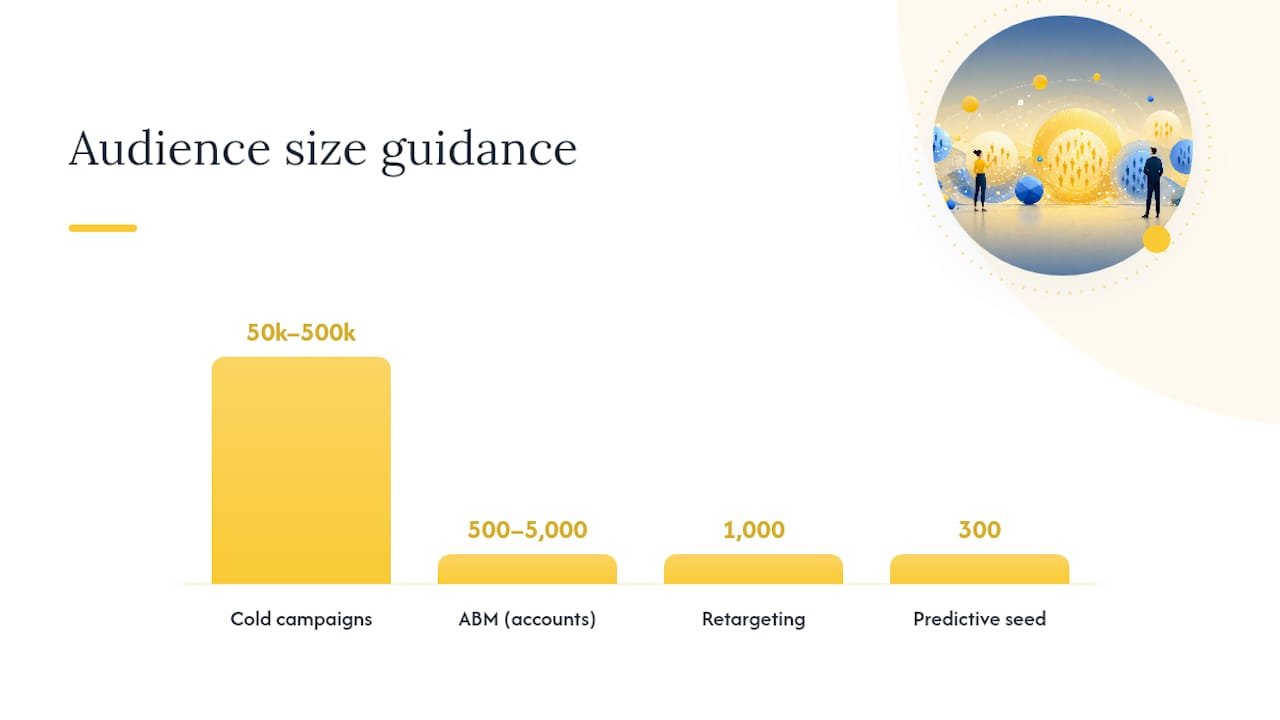
Audience size guidance:
- Cold campaigns: 50,000–500,000 members for healthy delivery.
- Retargeting: as small as 1,000 members, but watch frequency closely.
- ABM: audience size follows your account list; 500–5,000 members is typical.
Exclusions matter. Exclude current customers, employees, and competitors from cold campaigns. Exclude anyone who has already converted from lead-gen campaigns. Overlapping audiences inflate frequency and waste spend.
Retargeting windows: 30 days for high-intent actions (Lead Gen Form opens, website visits to pricing/demo pages); 90 days for content engagement (video views, document opens).
Pro Tip: Run personalized creative (mentioning the account or industry) alongside a non-personalized control ad in ABM campaigns. Personalized ads often fatigue faster; the control ad extends campaign life without sacrificing relevance.
LinkedIn’s country-level user data from Statista is useful for sizing geo-specific campaigns and deciding where to concentrate budget when you’re targeting multiple markets.
Creative and copy that converts B2B audiences
The single biggest creative mistake in B2B LinkedIn advertising is leading with the product. Your audience scrolls past vendor pitches. They stop for content that names their problem or their role specifically.
Copy formula for B2B headlines:
- Name the persona or the problem in the first five words.
- State the outcome, not the feature.
- One CTA, not three.
Format-specific creative rules:
- Single image: High contrast, minimal text on the image itself, and a headline that works without the visual. LinkedIn compresses images on mobile; don’t rely on small text.
- Video: The first three seconds must communicate who this is for and why they should keep watching. No logo animations, no slow fades. Cut to the point.
- Document Ads: The cover slide is the ad. Design it like a book cover, not a PowerPoint title slide. A strong title and a clear value promise (e.g., “The 2026 B2B Pipeline Playbook: 7 frameworks your team can use this quarter”) outperforms generic “Download our guide.”
- Thought Leader Ads: Write the post in first person from the executive’s voice. A personal observation or counterintuitive take performs better than a polished corporate announcement.
Lead Gen Form design by funnel stage:
- Top of funnel: First name, last name, email, job title. Four fields maximum. Any more and completion rates drop.
- Mid funnel: Add company name and phone number if your sales team needs it for routing.
- Bottom funnel: Add one qualifying question (“What’s your current annual revenue?” or “How many salespeople are on your team?”) to pre-qualify before routing to sales.
Using AI-assisted copywriting tools can speed up variant creation for A/B tests without sacrificing quality.
Do/don’t list:
- Do: Test two headlines per ad set before scaling spend.
- Do: Match the Lead Gen Form headline to the ad headline exactly.
- Don’t: Send cold traffic to a homepage. Build a dedicated landing page for each offer.
- Don’t: Use stock photos of people shaking hands. Real team photos or data visualizations outperform them.
Pro Tip: For video ads, add captions. A large share of LinkedIn video plays without sound, especially on mobile. Captions keep the message intact regardless of audio.
Bidding, budgets, and optimization routines
LinkedIn’s bidding options are simpler than Google’s, but the wrong choice at the wrong stage wastes significant budget.
Bidding decision flow:
- No conversion data yet? Use Maximum Delivery. Let LinkedIn optimize for impressions and clicks while you gather baseline data.
- Have 50+ conversions in the window? Switch to Target Cost to control CPL while maintaining volume.
- Running ABM or retargeting with a small audience? Use Manual CPC to control spend on a narrow audience where automated bidding can overpay.
Budget guidance:
- Pilot phase: $3,000–$5,000 per month minimum to generate statistically useful data across two to three campaigns. Below this, you’re not learning; you’re guessing.
- Scale phase: Once CPL is stable and SQL rate is consistent, increase budget in 20% increments per week rather than doubling overnight. Sudden budget jumps reset LinkedIn’s delivery algorithm.
Weekly optimization checklist:
- Check CTR by creative. Pause any ad below 0.4% CTR after 500 impressions.
- Review CPL trend. If CPL is rising week over week, check frequency first, then audience overlap.
- Confirm conversion tracking is firing. A broken Insight Tag is the most common silent budget drain.
- Review demographic breakdowns. LinkedIn often delivers to job titles or seniority levels outside your ICP; add exclusions when you spot drift.
- Rotate creative every 3–4 weeks for active campaigns to prevent fatigue.
Pro Tip: When launching a new campaign, duplicate your best-performing existing ad into it rather than starting with a blank creative. The duplicated ad carries its social proof signals, which helps early delivery and reduces the cold-start penalty.
How to measure LinkedIn ad performance and tie it to pipeline
Clicks and impressions don’t close deals. The measurement stack that actually matters for B2B connects LinkedIn activity to CRM opportunity records.
Minimum tracking checklist:
- LinkedIn Insight Tag on all site pages, with conversion events defined for key actions (demo request, form submit, pricing page visit).
- UTM parameters on every ad URL, consistent with your CRM’s source taxonomy.
- Lead Gen Form CRM connector (native integrations exist for Salesforce, HubSpot, and Marketo via LinkedIn’s Campaign Manager).
- LinkedIn Conversions API (CAPI) where server-side tracking is needed to fill gaps from browser-side signal loss.
KPIs by funnel stage:
| Metric | What It Signals | Recommended Action |
|---|---|---|
| CPM / Impression share | Audience reach and bid competitiveness | Adjust bid or broaden audience if CPM spikes |
| CTR (click-through rate) | Creative relevance | Pause ads below 0.4% CTR after 500 impressions |
| Engagement rate | Content resonance (Thought Leader, video) | Scale formats with >2% engagement |
| CPL (cost per lead) | Lead capture efficiency | Benchmark against industry; optimize form or creative |
| MQL rate | Lead quality from LinkedIn | Adjust targeting if MQL rate drops below baseline |
| SQL rate | Sales-readiness of LinkedIn leads | Flag audience or offer mismatch if SQL rate diverges |
| Pipeline influenced | Revenue impact | Primary B2B success metric; report monthly |
Attribution for B2B: Multi-touch, account-level attribution is the only model that reflects how B2B buying actually works. A single contact rarely converts alone; buying groups of 5–10 people typically touch multiple campaigns before a deal closes. Stitch LinkedIn campaign data to CRM opportunity records by matching Lead Gen Form submissions and UTM-tagged visits to account records. Report on pipeline influenced, not just leads generated.
Reporting cadence: Weekly for tactical metrics (CTR, CPL, frequency); monthly for pipeline and revenue attribution. Assign one owner for LinkedIn reporting who has access to both Campaign Manager and the CRM.
How to scale LinkedIn campaigns and avoid common mistakes
Scaling before a campaign is ready is the fastest way to multiply a bad CPL. The signals that a campaign is ready to scale are specific: stable CPL trend over three consecutive weeks, SQL rate consistent with your baseline, and buying group coverage across target accounts (not just one contact per account).
Scaling methods:
- Increase budget gradually: 20% per week maximum. Larger jumps disrupt delivery optimization.
- Duplicate campaigns with controlled changes: Test one variable at a time (new audience, new creative, new offer). Don’t change everything at once.
- Expand with Predictive Audiences: Once your seed audience has 300+ matched contacts and is performing well, activate LinkedIn’s Predictive Audiences to find similar profiles. Monitor quality closely for the first two weeks.
Common pitfalls and mitigations:
- Audience overlap: Multiple campaigns targeting the same members inflate frequency and split learning. Use LinkedIn’s Audience Overlap tool in Campaign Manager to check before launch.
- Frequency fatigue: B2B audiences are small. A frequency above 4–5 per member per month is a signal to rotate creative or expand the audience.
- Mixing audience types in one campaign: Cold and retargeting audiences in the same campaign produce muddled results. Keep them separate.
- Poor attribution: Reporting only on last-touch leads misses the account-level influence LinkedIn provides. Build multi-touch reporting before scaling.
Red-flag diagnostics:
- CPL rising for three consecutive weeks with no creative change: check frequency and audience overlap.
- CTR dropping without a budget change: creative fatigue; rotate immediately.
- MQL rate falling while lead volume holds: audience drift or offer mismatch; review demographic breakdown.
Pro Tip: Set a frequency cap of 4 impressions per member per week in Campaign Manager’s campaign settings. LinkedIn doesn’t enforce this automatically on all campaign types; you have to set it manually.
Agency-tested experiments worth running now
Search Engine Land’s 2025 B2B LinkedIn experiment report recommends five specific tests for 2026 based on client results: short-form video, Thought Leader Ads, personalized creative, Qualified Lead Optimization, and ad duplication. Here’s how to run each one.
-
Short-form video feed test
- Hypothesis: A 15–30 second video with a strong hook in the first three seconds will outperform a single image on CPL for cold audiences.
- Variants: Single image (control) vs. short-form video (test). Same audience, same offer, same budget split.
- Duration: 14 days minimum, 500 impressions per variant.
- Key metrics: CPL, CTR, video completion rate (25%, 50%, 75%).
-
Thought Leader boost vs. company post
- Hypothesis: Boosting a named executive’s organic post will generate higher engagement rate and lower CPL than a company-page Sponsored Content post.
- Variants: Thought Leader Ad (executive post) vs. standard Sponsored Content (company page).
- Duration: 14 days, same audience and budget.
- Key metrics: Engagement rate, CPL, comment quality.
-
Personalized creative vs. control
- Hypothesis: Creative that names the industry or role (“For SaaS VP of Sales”) will outperform generic creative on CTR and MQL rate.
- Variants: Personalized headline/image (test) vs. generic (control). Run in the same campaign.
- Key metrics: CTR, MQL rate, CPL.
-
Qualified Lead Optimization (CRM-seeded CAPI conversion test)
- Hypothesis: Optimizing for CRM-defined MQLs via LinkedIn CAPI will improve SQL rate compared with optimizing for raw Lead Gen Form submissions.
- Setup: Connect your CRM’s MQL stage to LinkedIn CAPI as a conversion event. Run one campaign optimizing for form fills and one for CAPI-defined MQLs.
- Duration: 30 days minimum (CAPI optimization needs more data to learn).
- Key metrics: SQL rate, CPL, pipeline influenced.
- Ad duplication speed test
- Hypothesis: Duplicating a top-performing ad (with social proof intact) into a new campaign will reach learning phase faster than launching a new creative.
- Setup: Duplicate the top ad into a new campaign targeting a new audience segment. Compare time-to-learning-phase vs. a fresh creative in the same audience.
- Key metrics: Days to exit learning phase, early CPL, CTR.
Measurement checklist for all tests:
- Set a baseline CPL and CTR from the previous 30 days before starting any test.
- Don’t declare a winner before 500 impressions and 14 days per variant.
- If a test shows early fatigue (CTR dropping after day 7), add a non-personalized control ad to extend campaign life.
Pro Tip: Mix personalized and non-personalized ads in the same campaign. When the personalized ad fatigues, the control ad picks up delivery without resetting the campaign’s learning data.
How LinkedIn Audience Insights sharpens your targeting
LinkedIn Audience Insights, available inside Campaign Manager, shows you the actual composition of your saved audience before you spend anything. It breaks down job function, seniority, industry, company size, and geography for any audience you define.
The practical use is targeting validation. Build your ICP-based audience, then open Audience Insights to confirm the distribution matches your actual buyer profile. Catching that before launch saves real money.
Audience Insights also reveals unexpected concentrations. A campaign targeting “enterprise software” companies might show heavy delivery in a geography or sub-industry you hadn’t prioritized. That’s a signal to either exclude it or build a dedicated campaign for it with tailored creative.
Use Insights iteratively: check it after the first week of a live campaign to see who LinkedIn is actually reaching versus who you intended to reach. Demographic drift is common, especially in broad cold campaigns. Tighten filters or add exclusions based on what you find.
Integrating LinkedIn campaigns with other marketing channels
LinkedIn rarely closes a deal on its own. B2B buyers research across LinkedIn, Google, review sites, and direct outreach before engaging sales. The programs that generate the most pipeline treat LinkedIn as one signal in a multi-channel account journey, not a standalone lead source.
The practical integration starts with UTM consistency. Every LinkedIn ad URL should carry source, medium, campaign, and content parameters that match the taxonomy your CRM and analytics platform use. Without that, LinkedIn’s contribution disappears into “direct” or “other” in your attribution model.
Pair LinkedIn retargeting with email sequences. When a contact opens a Lead Gen Form but doesn’t convert, trigger an email follow-up within 24 hours. The combination of LinkedIn impression and email touch increases response rates compared with either channel alone. Tools like HubSpot and Salesforce Marketing Cloud support this workflow natively. For a comparison of how LinkedIn paid activation stacks up against direct outreach channels, this analysis of email vs. LinkedIn outreach is worth reading before you decide how to weight each.
For Google Ads integration, build remarketing lists from LinkedIn Lead Gen Form submitters and target them with bottom-funnel search campaigns. Someone who downloaded your LinkedIn whitepaper and then searches for your category on Google is a high-intent signal worth capturing.
Report at the account level, not the contact level. A single account might have three contacts touched by LinkedIn, two by email, and one by a sales call. Account-level attribution in your CRM shows the full picture; contact-level reporting fragments it.
Frequency capping and managing ad fatigue in B2B
B2B audiences on LinkedIn are structurally small. A campaign targeting 500 named accounts with a buying group of five people each gives you roughly 2,500 addressable members. At any meaningful budget, you’ll reach frequency saturation fast.
The standard guidance is to cap frequency at 4–5 impressions per member per month for cold campaigns and 6–8 for retargeting, where higher frequency is expected and tolerated.
Creative rotation is the primary mitigation. Swap at least one creative element (headline, image, or CTA) every three to four weeks in active campaigns. You don’t need a full creative overhaul; changing the headline alone often resets engagement for another cycle.
Audience expansion is the secondary lever. When a retargeting audience is saturated, broaden the retargeting window (from 30 to 90 days) or add a new engagement trigger (e.g., include document ad openers alongside video viewers). LinkedIn’s frequency-of-use data from Statista shows that many LinkedIn members check the platform only a few times per week, which means frequency accumulates faster than daily-use platforms — a reason to monitor it more aggressively than you would on Facebook or Instagram.
Mixing Thought Leader Ads with standard Sponsored Content also extends campaign life. Members who’ve tuned out the company page post often engage with a named individual’s post on the same topic.
Budget allocation across campaigns and phases
Budget allocation in B2B LinkedIn advertising should follow the funnel, not the calendar. Spreading budget evenly across awareness, consideration, and conversion campaigns sounds balanced but usually means underfunding the stage where your ICP actually is.
Adjust these ratios as data accumulates. If retargeting CPL is significantly lower than cold CPL, shift budget toward retargeting until the retargeting pool saturates.
Phase your investment. In the first 60 days, prioritize data collection over conversion volume. Run cold campaigns at moderate budget, install all tracking, and let the Insight Tag build retargeting pools. In days 61–120, shift budget toward retargeting and Lead Gen Form campaigns where you have conversion data to optimize against. After month four, you have enough pipeline data to make a defensible case for scaling.
Seasonal budget adjustments matter in B2B. Q1 and Q3 tend to have lower CPMs as fewer advertisers compete; Q4 is expensive. If your sales cycle is 90 days, a Q1 LinkedIn push can influence Q2 pipeline at a lower cost per influenced opportunity than a Q4 push would.
For teams that want to integrate LinkedIn spend into a broader paid strategy, combining SEO and PPC investment alongside LinkedIn often produces compounding returns that neither channel achieves alone.
What actually works: an editorial perspective on B2B LinkedIn ads
The most persistent mistake I see in B2B LinkedIn programs is optimizing for the metric LinkedIn makes easiest to see rather than the one that actually matters. Campaign Manager surfaces CPL prominently. It does not surface pipeline influenced by default. So teams optimize for cheap leads, get cheap leads, and then wonder why sales is unimpressed.

The shift that changes outcomes is measuring at the account level and reporting on pipeline contribution monthly. That single change reframes every optimization decision. A $180 CPL from a named account that closes a $120,000 deal looks very different from a $60 CPL from a contact who never responds to sales. LinkedIn’s precision targeting is worth the premium only when you can see that premium reflected in deal quality.
The second thing most articles won’t tell you: Thought Leader Ads are underused not because they’re hard to set up but because they require an executive willing to post. That’s a people problem, not a platform problem. The teams that solve it by getting one or two executives to post consistently see measurable engagement lifts that company-page content rarely matches. It’s worth the internal conversation.
Short-form video is the format with the most upside right now. Production cost is low, LinkedIn’s algorithm favors it, and most B2B advertisers still default to static images. The window where video gives you a disproportionate advantage won’t stay open indefinitely.
Envisionmarketingagency’s approach to B2B LinkedIn ad strategy
Running LinkedIn ads for B2B without a clear measurement framework is expensive guesswork. Envisionmarketingagency builds programs that skip that phase: from ICP definition and account list upload to Lead Gen Form setup, CRM integration, and a reporting dashboard that shows pipeline influenced, not just leads generated.
The engagement options are structured around where you are: a campaign audit if you’re already running ads and want an outside read on what’s broken, a pilot campaign (60 days, defined deliverables, clear CPL targets) if you’re starting from scratch, or a managed retainer for teams that want ongoing campaign management, creative production, and monthly reporting. Envisionmarketingagency has served over 550 clients since 2020, and LinkedIn campaign management sits inside a broader digital program that includes SEO, web design, and paid search — so LinkedIn doesn’t run in isolation from the rest of your GTM.
If your LinkedIn spend isn’t generating pipeline you can point to, schedule a strategy call with Envisionmarketingagency to see what a properly instrumented program looks like.
Sources
The sources below were used throughout this guide and are worth bookmarking for deeper technical setup and ongoing benchmarking.