

In 2026, expect to pay a range of costs per thousand impressions (CPM) and per click (CPC) across major networks, with significant variation by platform and industry. Start with a test budget of a modest daily amount for a one- to two-week period per platform before scaling. Judge results by ROAS and CPA, not likes or reach.
TL;DR:
- Social media ad costs vary significantly by platform, with TikTok often costing $0.01 to $0.03 per view and LinkedIn reaching over $15 per click.
- Running small-scale tests with daily budgets of $5 to $50 for at least one to two weeks provides clearer data before scaling campaigns.
- Cost-efficient advertising depends on achieving a ROAS of four times the ad spend, meaning CPAs should stay below your target revenue per customer.
- Creative production and tracking setup often account for hidden costs that can outpace media spend, especially for small businesses.
- Agencies focus on structured testing, measurement, and scaling around ROAS thresholds, making them valuable after initial testing and validation.
Table of Contents
- How Much Do Social Media Ads Cost by Platform?
- What Do CPC, CPM, CPA, and ROAS Actually Mean?
- How Should You Set a Test Budget and Scale It?
- Why Do Costs Vary So Much by Industry?
- How Does an Agency Approach Social Ad Budgeting?
- Are There Hidden Fees Beyond the Ad Spend Itself?
- When Does It Make Sense to Hire an Agency vs. Run Ads In-House?
- Get Help Planning a Social Ad Budget That Actually Performs
- Sources
How Much Do Social Media Ads Cost by Platform?
Platform choice changes your cost of social media advertising more than almost any other decision you’ll make. A dollar on LinkedIn buys a different audience, and a different price, than a dollar on TikTok.
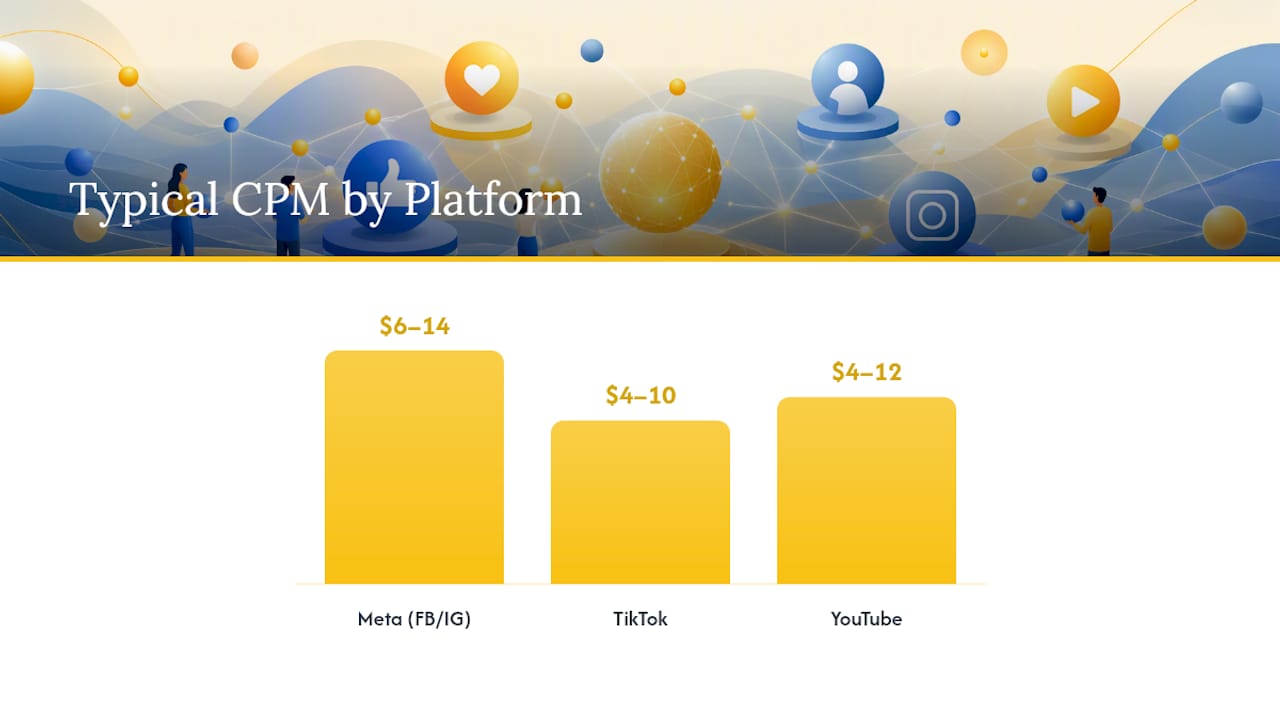
Meta (Facebook and Instagram) remains the default starting point for most small businesses, and for good reason: it has the deepest targeting data and the widest inventory. CPMs typically range in the single-digit to low double-digit amounts, while CPC varies depending on your objective. Feed placements tend to cost less per click than Stories or Reels, though Reels may sometimes deliver cheaper reach as Meta promotes that format. Carousel and video ads generally outperform static images on cost-per-result once you get past the first week of the learning phase.
TikTok runs on a cost-per-view (CPV) model for many campaign types, with typical CPV in the $0.01 to $0.03 range and CPM often between $4 and $10. The platform requires a $20 daily minimum at the ad group level, which matters if you’re testing on a shoestring. TikTok’s cost advantage shows up mostly in awareness and top-of-funnel campaigns; cold-traffic conversion costs can climb fast without a retargeting layer behind them.
YouTube ads, particularly skippable in-stream formats, price out around $0.10 to $0.30 per view (CPV), with CPM in the $4 to $12 band depending on targeting precision and competition in your niche. Because YouTube only charges when someone watches 30 seconds or engages, it can be one of the more forgiving platforms for testing longer-form creative without burning through budget on impressions that never land.
LinkedIn is the outlier, and it’s supposed to be. CPC commonly runs $5 to $15, with CPM sometimes exceeding $30 for tightly filtered B2B audiences. That’s expensive by social standards, but if your average deal size is $5,000 or more, a $12 click that leads to one qualified lead a week can still deliver strong ROAS. LinkedIn only earns its premium price when your funnel and offer are mature enough to convert that traffic; running LinkedIn ads with a weak landing page is one of the fastest ways to burn a monthly budget with nothing to show for it.
Pinterest tends to run cheaper than Meta for retail and lifestyle brands, with CPC often in the $0.10 to $1.50 range, especially for shopping-intent creative. X (formerly Twitter) sits in a similar band to Meta but with less targeting precision, and results vary widely by industry. Snapchat skews younger and cheaper on CPM, typically $2.50 to $10, but works best paired with vertical video creative built specifically for the platform rather than repurposed Instagram assets.
| Platform | Typical CPM | Typical CPC | Notes |
|---|---|---|---|
| Meta (Facebook/Instagram) | $6–$14 | $0.30 | Reels often cheaper than feed |
| TikTok | $4–$10 | CPV $0.01–$0.03 | $20/day minimum per ad group |
| YouTube | $4–$12 | CPV $0.10–$0.30 | Charged per view/engagement |
| $15–$30+ | $5–$15 | Best for high-value B2B offers | |
| $3–$10 | $0.10–$1.50 | Strong for shopping intent | |
| X | $5–$12 | $0.30 | Varies widely by industry |
| Snapchat | $2.50–$10 | $0.30–$1.50 | Needs native vertical creative |
These bands move constantly with auction demand and seasonality, and any platform cost breakdown should be treated as a planning range, not a quote.
What Do CPC, CPM, CPA, and ROAS Actually Mean?
Every ad platform’s pricing comes down to a handful of metrics, and once you understand the math, you can convert a raw CPM into an actual budget forecast.
- CPM (cost per 1,000 impressions): what you pay for reach, regardless of clicks.
- CPC (cost per click): total spend divided by clicks.
- CTR (click-through rate): clicks divided by impressions, usually shown as a percent.
- CPA (cost per acquisition): total spend divided by conversions.
- ROAS (return on ad spend): revenue divided by ad spend.
That works out to $0.80 per click. If 5% of those clicks convert, you get half a conversion per 1,000 impressions, or a CPA of $16.
Below that threshold, you’re reading noise, not signal.
If your target ROAS is 4x on a $50 product, you can afford a CPA up to $12.50. Work backward from that number to decide whether a platform’s typical CPC makes sense for your offer before you spend a dollar. Ad relevance and quality score also factor into auction price. Platforms reward ads that generate strong engagement with cheaper delivery, which is why a mediocre ad on a big budget often loses to a sharp one on a small budget.
How Should You Set a Test Budget and Scale It?
Budgeting for social ads is less about picking a number and more about running a structured experiment. Here’s a sequence that works for most SMBs entering a new platform.
- Pick two platforms, not five. Spreading a small budget thin across every network guarantees none of them reach the volume needed to learn anything.
- Set a daily test budget of $5 to $50 per platform, matching the low end for awareness tests and the high end when you’re testing conversion campaigns directly. Hootsuite’s guidance backs this range as enough to generate usable signal without overcommitting.
- Run each test for 7 to 14 days minimum. This lets the algorithm exit the learning phase, where delivery is unstable and costs run higher than they will once the system optimizes.
- Set a decision threshold before you launch, not after. Define what ROAS or CPA counts as a win so you’re not rationalizing a loser after the fact.
- Scale winners in increments of 20% to 50%, not by doubling overnight. Sudden budget jumps reset the learning phase and often spike your CPA right when you thought you’d cracked the formula.
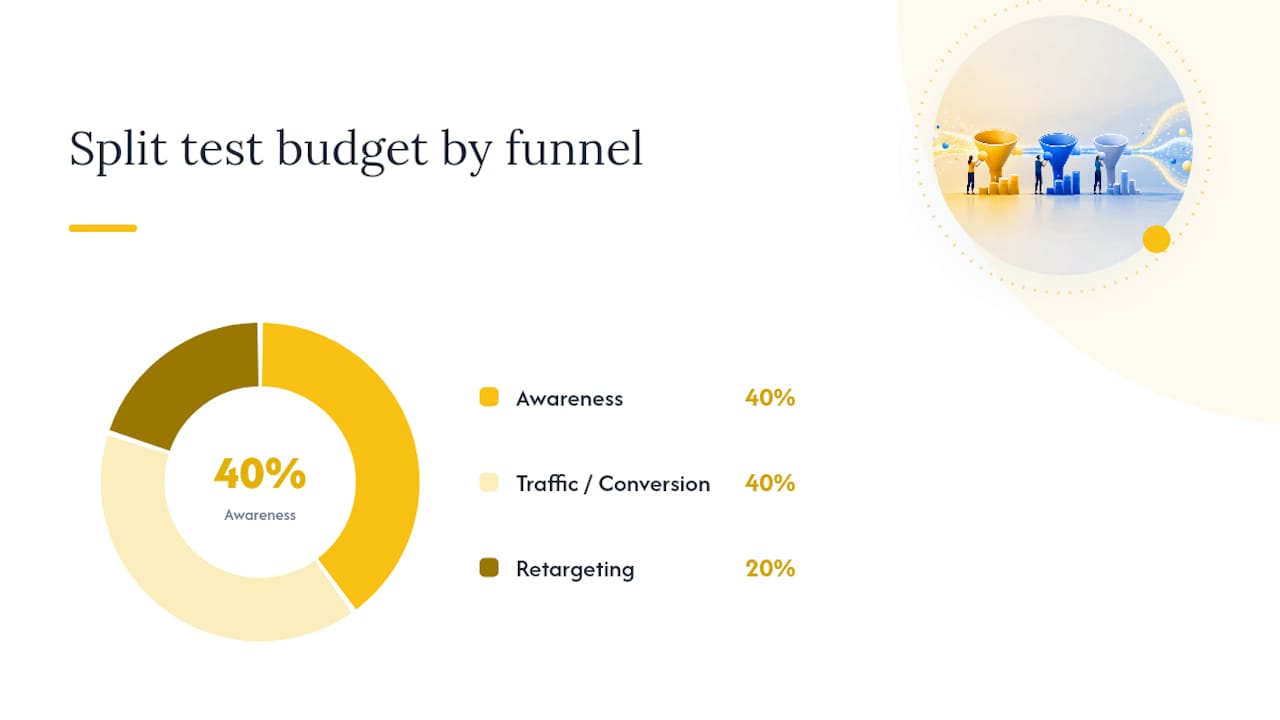
- Split budget across funnel stages: a common starting mix is 40% awareness, 40% traffic or conversion, and 20% retargeting, adjusted once you see which stage actually drives revenue.
- Build creative production and tracking costs into the budget, not around it. A $500 monthly media budget with zero dollars for creative or conversion tracking setup is really a $500 budget with a blind spot.
Pro Tip: Treat your first two weeks on any new platform as a data-collection exercise, not a revenue test. The goal is learning what a qualified click costs you, not hitting ROAS targets on day three.
For a deeper look at scaling decisions once a campaign proves itself, this breakdown of return on ad spend optimization walks through the thresholds worth watching before you increase spend. And if the marketing line item is competing with payroll and inventory in your budget, this small business budgeting guide is worth a look before you commit to a monthly ad number.
Why Do Costs Vary So Much by Industry?
Median social media ad spend rose sharply for ecommerce brands, with Emplifi’s Q2 2026 benchmark data showing a 70% year-over-year jump in median monthly spend while CPC dropped 18% at the same time. That’s the opposite of what most advertisers expect. Usually more competition drives prices up. Here, brands got more efficient even as they spent more, largely because platforms rewarded stronger creative and better-targeted retargeting pools with cheaper delivery.
In the U.S. specifically, median monthly spend rose 57% with CPC landing around $0.483, and some ecommerce datasets from Emplifi showed CPC falling as low as $0.133 in categories with tight creative and funnel alignment.
- Small accounts (spending under a few thousand dollars a month) tend to see wider cost swings because volume is too low to smooth out auction noise.
- Mid-level accounts benefit from more stable delivery and can negotiate better efficiency simply through scale.
- B2B, finance, and healthcare advertisers usually pay more per click across every platform because their audiences are narrower, their sales cycles are longer, and platforms price scarcity into the auction.
Statista’s ongoing ad-spend tracking gives useful context for sizing a monthly budget against overall market growth, particularly if you’re trying to figure out whether your spend is competitive for your account size.
How Does an Agency Approach Social Ad Budgeting?
Some agencies structure paid social work around three phases: a discovery period that audits existing data and defines realistic cost benchmarks for the client’s industry, a measurement-first test plan that runs structured experiments before committing to scale, and a scaling cycle built around ROAS thresholds rather than arbitrary spend increases.
- Agencies typically bill either a flat monthly retainer or a percentage of ad spend, commonly in the 10% to 20% range.
- Deliverables should include creative production, tracking setup, weekly or monthly reporting, and a documented test plan, not just campaign launches.
- Look for a social media ads management partner that shows past portfolio work tied to measurable outcomes, not just impressions delivered.
Are There Hidden Fees Beyond the Ad Spend Itself?
The number you set as your daily budget is rarely the full cost of running social ads. Payment processing fees, currency conversion charges for international targeting, and platform-specific costs like Meta’s per-click charges on link clicks versus engagement clicks can all shift your effective CPC without showing up as a separate line item.
Creative production is the biggest hidden cost most SMBs underestimate. A single polished video ad can run anywhere from a few hundred to several thousand dollars depending on whether you’re shooting original footage or repurposing existing assets, and that cost sits entirely outside your media budget.
Agency management fees, if you go that route, typically layer on top of ad spend rather than coming out of it, so a $2,000 monthly media budget with a 15% management fee actually costs $2,300 total. Some platforms also charge more for certain ad placements or targeting options, like LinkedIn’s premium audience filters, which can quietly push your effective CPM higher than the headline benchmark suggests. Budget for these extras before you commit to a monthly number, not after you’ve already spent it.
When Does It Make Sense to Hire an Agency vs. Run Ads In-House?
Running ads in-house makes sense while you’re still testing which platform fits your offer. Once you’ve validated a channel and need consistent creative output, tracking hygiene, and someone watching the auction daily, that’s usually the point where in-house effort starts costing more in missed opportunity than an agency fee would.
Before hiring anyone, run at least two 14-day tests yourself. You’ll learn more about your actual CPA in that time than any pitch deck can tell you, and you’ll ask sharper questions when you do bring in outside help.
— Marcus
Get Help Planning a Social Ad Budget That Actually Performs
Building a monthly budget from CPM benchmarks is one thing. Turning that budget into consistent leads without babysitting the ad account every day is another problem entirely, and it’s the one most SMBs actually struggle with.
Some agencies run social ad management with a measurement-first test plan, creative built for the platform rather than repurposed from somewhere else, and reporting tied to ROAS and CPA instead of impressions. That combination matters because a campaign with the right budget and the wrong landing page still fails, which is why paid social work here often pairs with conversion-focused web design to make sure the traffic you’re paying for actually converts once it lands. If you’re weighing whether to keep testing solo or bring in support to manage the budget and creative pipeline, the full digital marketing services page outlines what a managed campaign includes and how to book a consult to walk through your numbers.
Sources
- Social media advertising: Ads, cost & strategies – Hootsuite
- Ecommerce social media ad spend surged 70% as brands got more for every dollar – Emplifi / PR Newswire
- Social Media Ads Cost Breakdown: Facebook, Instagram, TikTok, Pinterest and More – AdRoll
- Social media advertising – United States | Statista